Imagine asking your data a question in plain English and instantly getting a trusted, actionable answer without writing a single line of SQL. That’s the promise of Snowflake Intelligence, Snowflake’s generative AI-powered platform that transforms how organizations interact with data, bridging silos, automating insights, and empowering every user to make smarter decisions.
In this blog, we’ll explore how Snowflake Intelligence works, its core components, real-world use cases across industries, and the business value it delivers, showing how enterprises can turn fragmented data into actionable intelligence with speed, accuracy, and trust.
What is Snowflake Intelligence?
Snowflake Intelligence is Snowflake’s new generative AI-powered interface that allows users to query, analyze, and visualize data through natural language conversations, without needing to code, build dashboards, or configure separate tools.
It represents the evolution of Snowflake’s data intelligence capabilities built directly into the Snowflake platform under the AI & ML section. It combines the power of Cortex Agents, Cortex Search, and Cortex Analysis to unify structured and unstructured data interactions.
Unlike traditional BI tools or custom-built AI apps, Snowflake Intelligence is a finished, native product — users can instantly start asking questions and generating insights from across their enterprise datasets through an intuitive chat-style graphical interface.
Core Architecture & Components
Snowflake Intelligence is powered by the Snowflake Cortex framework, which provides the underlying AI and data orchestration engine. Snowflake Cortex, the intelligent orchestration framework enables reasoning, retrieval, and tool use inside Snowflake. It consists of three major components:
- Cortex Analyst
This is where text-to-SQL reasoning happens. Cortex Analyst converts natural language questions into accurate, context-aware SQL queries using semantic models. It bridges the gap between human intent and data logic, empowering anyone to explore structured data effortlessly.
- Cortex Search
Designed for retrieval over unstructured content, Cortex Search unifies keyword and vector search across PDFs, documents, transcripts, and even images. It enables seamless access to enterprise knowledge—structured or unstructured—within a single environment.
- Cortex Agents
Acting as the reasoning and orchestration layer, Cortex Agents break down complex queries into smaller, manageable tasks. They automatically select the right tools, synthesize the results, and deliver clear, natural-language responses—grounded in real, governed data.
Together, these components transform Snowflake into an intelligent, end-to-end platform where users can ask, discover, and act confidently and at scale.
Custom Tool Integration
Cortex enables users to enhance agent functionality with custom-built tools that connect Snowflake data to external sources. For example, a team could create a web scraping tool to gather product insights from an external site, like pickleballcentral.com, and instantly compare them against internal product catalog data stored in Snowflake. This capability opens the door to limitless, context-rich analytics powered by both internal and external intelligence.
Intelligence Interface (Frontend)
Within the Snowflake UI, users experience a chat-based conversational interface where they can ask natural-language questions like “Compare sales performance between North America and EMEA last quarter.” Cortex instantly translates these prompts into data queries, returning visualized, explainable insights; no coding or SQL expertise required.
Security and Governance Layer
Every interaction within Cortex inherits Snowflake’s native security and governance framework. Features such as role-based access control (RBAC) and data isolation ensure that queries and LLM interactions remain fully secure, private, and compliant across accounts.
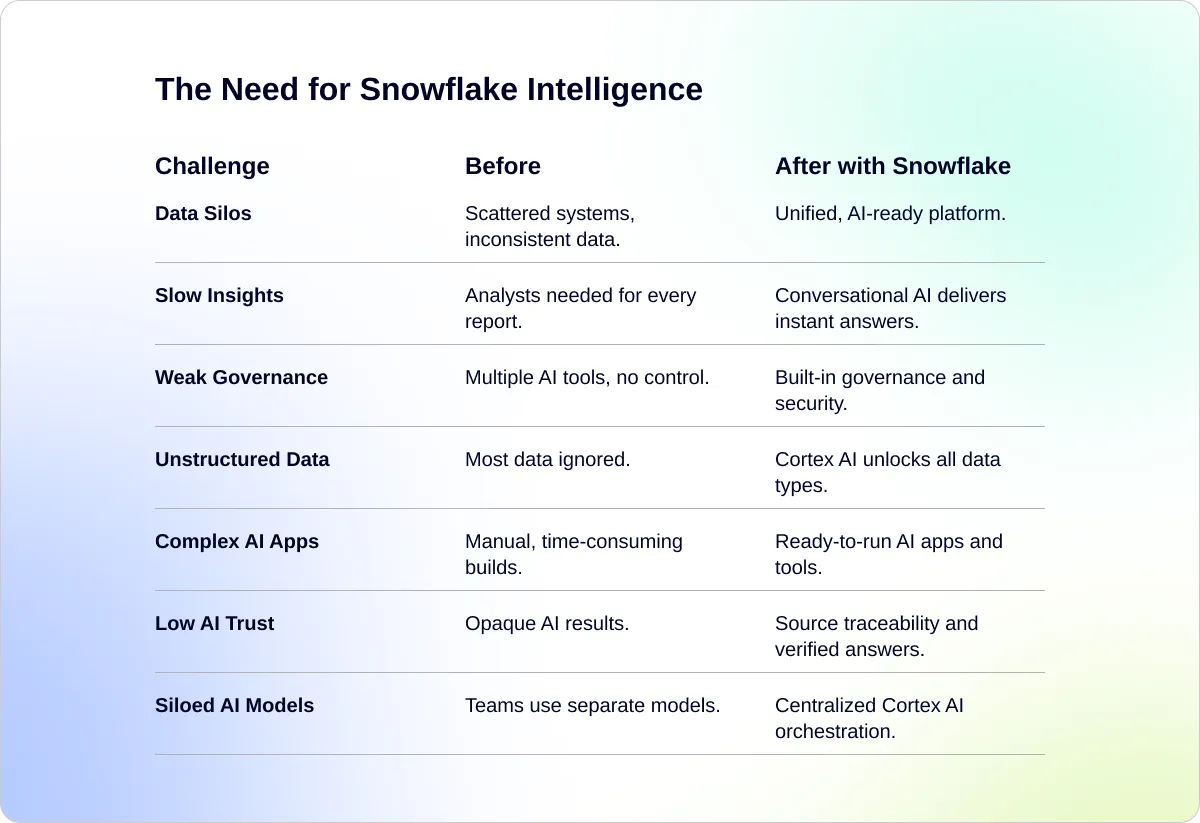
Why Enterprises Struggle with Data – and How Snowflake Intelligence Solves It
Many enterprises face many obstacles that limit their ability to fully leverage AI and data analytics. From fragmented data to governance gaps, the complexity of managing disconnected systems slowed innovation and increased operational risk.
1. Data Fragmentation
Most organizations manage vast amounts of data across multiple platforms like Salesforce, Workday, ERP systems, marketing tools, cloud apps, and custom data stores. This fragmentation creates:
- Inconsistent metrics and reporting logic.
- Slow data discovery and access.
- Limited cross-departmental visibility.
The Snowflake Intelligence Solution:
Snowflake unifies all data types (structured, semi-structured, and unstructured) into one AI-ready platform. This integration breaks down silos, enabling seamless access and collaboration across the organization.
2. Dependence on Specialists
Traditional analytics rely heavily on analysts to manually generate insights, dashboards, and reports. This process is time-consuming and often delays decision-making. Even with self-service BI tools, users often rely on:
- Data analysts to translate questions into SQL.
- Engineers to maintain dashboards.
- Separate teams to interpret unstructured data (emails, documents, and transcripts).
This slows insight generation and limits agility.
The Snowflake Intelligence Solution:
With Conversational AI, users can automatically generate charts, SQL queries, and summaries through natural language. This democratizes analytics, empowering anyone to extract insights without deep technical expertise.
3. Governance Risk
As enterprises experiment with multiple AI tools and LLMs (OpenAI, Anthropic, local models, etc.), data becomes dispersed, governance is weakened, and outputs vary in accuracy or traceability. Snowflake refers to this as the “GenAI Wild West” — where innovation happens fast, but trust and control lag.
The Snowflake Intelligence Solution:
Snowflake provides built-in governance, including data masking, role-based access control (RBAC), and policy management—ensuring every AI interaction remains secure and compliant.
4. Unstructured Data Challenge
Over 80% of enterprise data is unstructured (PDFs, call transcripts, contracts, or product reviews). Traditional analytics pipelines ignore this, creating massive blind spots in decision-making.
The Snowflake Intelligence Solution:
Deep integration with Cortex AI for structured + unstructured reasoning.
5. Complex AI App Development
Building custom AI applications traditionally requires extensive development effort integrating interfaces, connectors, and APIs manually.
The Snowflake Intelligence Solution:
With Snowflake’s ready-to-run, managed applications, teams can develop and deploy AI tools faster, using prebuilt interfaces and integrated frameworks that simplify the entire process.
6. Limited AI Transparency
Users often hesitated to trust AI-generated answers due to limited visibility into data sources and reasoning.
The Snowflake Intelligence Solution:
Snowflake introduces source traceability and “verified by data team” indicators, giving users full visibility into how results are generated, restoring trust in AI-driven insights.
7. Siloed AI Use Cases
Different departments frequently adopted separate AI models, leading to inconsistency, inefficiency, and duplication of effort.
The Snowflake Intelligence Solution:
Snowflake’s Cortex framework centralizes AI orchestration, connecting all models and workflows across the enterprise. This unified approach ensures consistency, scalability, and shared intelligence across every team.
Why Snowflake Intelligence Is a Game Changer for Customers
Snowflake Intelligence is a defining leap forward in how organizations interact with data, shifting from traditional SQL-based analytics to AI-driven conversation and reasoning.
By combining the power of Cortex Agents with a secure, native, and intuitive interface, Snowflake empowers teams to turn data into decisions faster, smarter, and more collaboratively, all within the same trusted platform.
Strategic Vision: From Data Warehouses to Intelligence Clouds
Snowflake Intelligence marks a fundamental evolution, from storing and analyzing data to understanding, reasoning, and acting on it. This transformation positions Snowflake not just as a data platform, but as an enterprise reasoning engine built for the AI era.
It enables organizations to:
- Understand human questions through natural-language interaction.
- Reason across all data types, from structured tables to unstructured content.
- Act securely with governance built into every process.
- Deliver trusted insights instantly, grounded in enterprise data.
In essence, Snowflake Intelligence redefines how modern businesses consume, govern, and scale AI responsibly, making intelligent decision-making a core part of everyday operations.
The Business Value of Snowflake Intelligence
As organizations accelerate their journey toward AI-driven transformation, the question is no longer if they’ll adopt AI but how to do it responsibly, efficiently, and at scale. Snowflake Intelligence bridges that gap, empowering every business function to access, understand, and act on data with unprecedented speed and trust.
Here’s how Snowflake Intelligence delivers measurable business value across the enterprise:
1. Democratized AI
Snowflake Intelligence puts the power of data in everyone’s hands. Business users can query data in plain English—no SQL or BI experience required. This accessibility removes technical barriers, turning every employee into a data-driven decision-maker.
2. Accelerated Decision-Making
With real-time access to accurate and trusted insights, teams can act faster and with greater confidence. Snowflake Intelligence enables continuous, data-driven decision loops, transforming how organizations respond to market shifts and operational challenges.
3. Cost Efficiency
By eliminating the need for separate AI infrastructure or third-party tools, Snowflake Intelligence streamlines costs and reduces complexity. It minimizes reliance on unmanaged GenAI experiments and external APIs, consolidating AI operations into a single, secure platform.
4. Enhanced Collaboration
Teams no longer need to work in isolation. Departmental agents and insights can be shared seamlessly across business units, while conversations, queries, and visualizations are easily exportable, fueling alignment and faster collective action.
5. Increased Trust in AI
Transparency is at the heart of Snowflake Intelligence.
Every response comes with verified sources and explainable reasoning, ensuring decisions are grounded in truth. With built-in governance and compliance, organizations can scale AI safely and confidently.
Industry Impact: Real-World Use Cases of Snowflake Intelligence
Snowflake Intelligence empowers teams across industries to make smarter, faster decisions by turning natural-language queries into AI-driven insights from across all data. Here are some concrete examples of how Snowflake Intelligence drives impact across key domains:
Finance
Example Query: “Summarize Q3 revenue and expense trends.” Finance teams can instantly generate comprehensive reports and forecasts without waiting for manual SQL queries or dashboard updates. Snowflake Intelligence accelerates financial planning, enhances accuracy, and supports faster decision-making in a constantly changing market.
Sales
Example Query: “Which regions saw the highest YoY growth?”
Sales leaders can quickly analyze performance across regions and channels, identifying growth opportunities and underperforming areas. This empowers cross-region optimization, more effective quota setting, and smarter resource allocation.
Human Resources (HR)
Example Query: “What’s the attrition rate by department?”
HR teams gain real-time visibility into workforce dynamics. By analyzing employee trends, turnover patterns, and departmental performance, organizations can proactively manage talent retention, enhance engagement, and plan for future hiring needs.
Marketing
Example Query: “Summarize top-performing campaigns.”
Marketing teams can evaluate campaign effectiveness in real time, measuring engagement, conversions, and ROI. Snowflake Intelligence allows marketers to quickly pivot strategies, optimize spend, and better attribute results to specific channels or initiatives.
Retail
Example Query: “Compare our product catalog to pickleballcentral.com.”
Retailers can perform competitive analyses that combine internal sales and inventory data with external market intelligence. This enables smarter pricing, optimized product assortment, and more effective promotions, helping brands stay ahead in fast-moving markets.
Delivering actionable insights across these domains, and many more, Snowflake Intelligence helps organizations break down silos, accelerate decision-making, and create a truly data-driven enterprise.
Getting Started with Snowflake Intelligence
To help customers see Snowflake Intelligence in action, let’s walk through a practical demonstration that highlights its capabilities.
In this scenario, a Sales and Product Agent was configured to integrate both internal catalog data and external product site information. The user posed a natural-language question:
“Get insights from pickleballcentral.com compared to our internal product catalog stored in Snowflake.”
Here’s how Snowflake Intelligence handled it:
- Custom Web-Scraping Tool: Extracted live product data from the external website.
- Data Integration: Cross-referenced external data with the internal Snowflake dataset.
- Insight Delivery: Presented a summarized, actionable analysis directly through the conversational interface.
This demonstration showcases how Snowflake Intelligence can seamlessly blend internal and external data, enabling teams to generate meaningful insights without complex queries or manual data consolidation.
Amplifying AI Impact: How BlueCloud Elevates Snowflake Intelligence
BlueCloud helps organizations turn Snowflake Intelligence from a new product into an operational, enterprise-wide capability. Because the product is new, most organizations will need support preparing their data, defining agent behavior, and identifying high-value use cases. BlueCloud accelerates adoption by:
- Building the data foundation required for Snowflake Intelligence to work accurately — modeling, cleaning, and unifying structured + unstructured data so Cortex Analyst and Cortex Search return reliable insights.
- Designing and configuring Cortex Agents around specific business functions (Finance, HR, Sales, Marketing), including prompt design, guardrails, and agent tasks.
- Developing custom agent “tools” that allow Snowflake Intelligence to pull from external APIs, competitor sites, or source systems and enrich insights with external context.
- Creating the AI adoption roadmap, including change management, user enablement, security/governance configuration, and KPIs that measure value (reduced BI backlog, faster time to insight, etc.).
The result: when Snowflake Intelligence launches, customers already have the data foundation, agent design, and operational plan required for immediate value, not a months-long experimentation phase.

Empower Every Decision with Snowflake Intelligence and BlueCloud
Snowflake Intelligence brings AI, data, and governance together to help every user turn information into intelligent, confident decisions. It’s the next step in secure, AI-driven transformation.
Learn more about Snowflake Intelligence and see how BlueCloud can help you build your AI-ready data foundation.