TL;DR
- Snowflake migrations fail because organizations move existing chaos to a new platform. Report sprawl, duplicate metrics, and tangled pipelines follow you unless you rationalize before you migrate.
- BlueCloud inventories and classifies every report before migration begins, typically removing 40-60% of report sprawl and reducing scope, cost, and timelines from day one.
- BlueCloud prioritizes the 5-10 data sources driving 80% of business value, creating early wins without inheriting legacy inconsistencies from lower-priority workloads.
- BlueCloud embeds Snowflake Cortex Code into every engineer's workflow, automating repetitive patterns while architects own the critical decisions.
Migrations fail when you dive into the spiderweb with no plan. The smartest teams untangle it first.
Modern data migrations are rarely derailed by technology. They fail because organizations attempt to “lift and shift” chaos. Hundreds of reports. Conflicting KPIs. Overlapping pipelines. No ownership. No roadmap.
Then the migration starts. And the mess simply moves to a new platform.
Before you move a single report, rewrite a single SQL query, or spin up Snowflake compute, you need to answer a harder question:
What exactly are you moving and why?
This blog explores how to rationalize your BI and modernize your analytics stack before migrating to Snowflake, ensuring migrations deliver real value instead of moving chaos.
The Hidden Cost of BI Chaos
Most enterprises don’t realize how tangled their BI ecosystem has become until they attempt to modernize it. Here’s what we typically uncover.
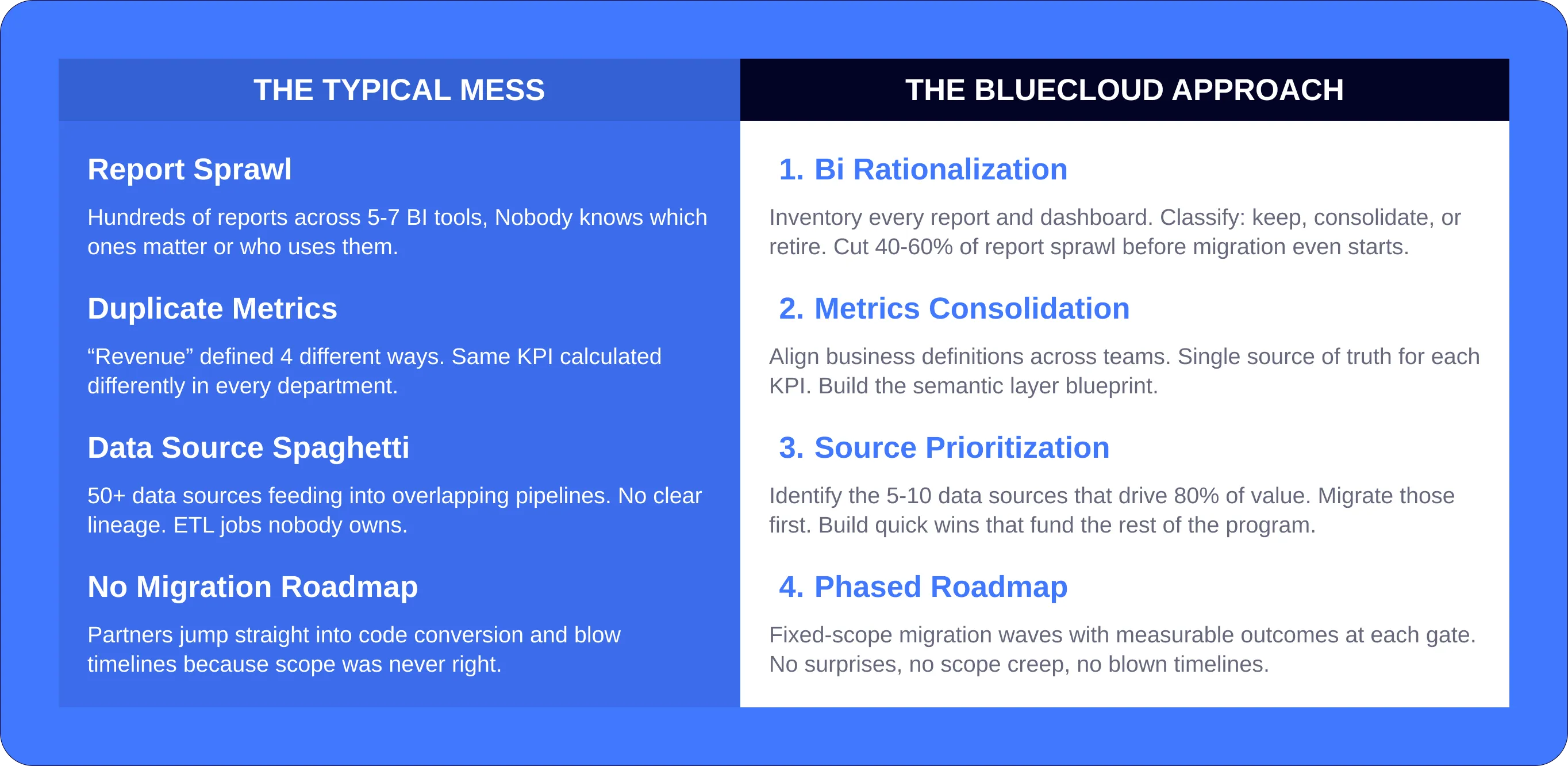
Challenge 1: Report Sprawl at Enterprise Scale
Your customer says:
“We have 3,000 reports across Cognos, SSRS, and Tableau and nobody knows which ones matter.”
“We’re paying for 500 Tableau licenses but only 80 people use it regularly.”
Across organizations, we consistently see thousands of reports spread across five to seven different BI tools, creating fragmented visibility and overlapping functionality. Duplicate dashboards often attempt to solve the same business problem, while one-off reports built for temporary needs are rarely retired, quietly accumulating over time.
Without a clear ownership model to govern what gets created, maintained, or decommissioned, the BI environment becomes cluttered, inefficient, and increasingly difficult to trust.
The result?
Massive license waste. Low user trust. Slow performance. Zero clarity.
Migrating all of it just transfers technical debt to a modern platform.
Most legacy BI migrations fail not because of technology, but because of accumulated clutter. When unused dashboards and redundant metrics are migrated alongside critical reports, complexity multiplies. Engineers spend weeks rebuilding assets no one touches. Validation cycles drag. Adoption suffers because users still don’t trust numbers.
At BlueCloud, we take a different approach. Before we migrate anything, we rationalize everything.
Our governance-first methodology ensures that what moves forward is optimized, aligned, and built for scale. Instead of lifting and shifting technical debt into Snowflake, we help you eliminate it.
We begin with a full inventory of your reporting landscape. Every report. Every dashboard. Every dependency. Then we evaluate them through a structured lens:
- Which assets are actively used and strategically important?
- Which are redundant or overlapping?
- Which no longer deliver value?
Each report is classified as keep, consolidate, or retire.
This rationalization process is supported by automated report inventory, usage analytics scoring, and structured consolidation roadmaps.
Armed with insights from the initial discovery, BlueCloud uses AI-powered Cortex Code to rationalize BI and modernize analytics, resulting in a consolidated, streamlined, and future-ready Snowflake environment.
Cortex automatically scans code to classify complexity and dependencies, generates source-to-target mapping proposals, and identifies dead code, unused objects, and redundant pipelines.
The Impact
Fewer reports mean fewer rebuild cycles. Fewer rebuild cycles mean shorter timelines.
Shorter timelines mean lower costs. But the real benefit goes deeper.
By consolidating metrics and aligning definitions before migration, you establish a clean semantic foundation inside Snowflake. Revenue means the same thing across departments. KPIs are defined once. Governance is embedded from day one.
Modernization isn’t about moving everything. It’s about moving forward intentionally, efficiently, and with a platform designed for growth.
Challenge 2: Duplicate Metrics
The revenue is defined in four different ways across the organization, and the same KPI is calculated differently in every department. What should be a shared measure of performance becomes a source of confusion and debate.
When these definitions aren’t aligned before migration, the inconsistencies follow you into the new platform. And rebuilding that conflicting logic in Snowflake doesn’t fix the problem. It hardens it, embedding misalignment into your modern architecture and making it even harder to untangle later.
We align business definitions across teams and establish a single source of truth for each KPI before any transformation scripts are rewritten. By building the semantic layer blueprint first, we ensure that when Snowflake becomes your foundation, your metrics are unified and not fragmented.
Challenge 3: Data Gordian Knot
Imagine fifty, or more, data sources all feeding overlapping pipelines, with no clear lineage and ETL jobs that nobody owns. Migration projects often don’t solve this. They simply rebuild the same complexity in a modern environment, just on shinier infrastructure.
The result? Expensive technical debt disguised as progress.
Not all data drives equal value.
Instead of trying to “boil the ocean,” we focus on the 5–10 data sources that generate roughly 80% of business impact. By migrating these first, we create early wins that fund the broader program and reduce risk from the outset.
Intelligent sequencing ensures effort is aligned with impact, so every move counts.
Challenge 4: No Migration Roadmap
Too often, partners dive straight into code conversion without stepping back to see the bigger picture. Pipelines get rebuilt before the full scope is understood, reports are migrated without analyzing actual usage, and hidden dependencies are overlooked, creating confusion before the migration even begins.
This often leads to blown timelines, uncontrolled scope creep, and frustrated stakeholders.
Breaking the migration into well-defined waves with fixed scope and measurable outcomes keeps surprises in check and prevents scope creep. Each phase delivers standalone value while actively building toward a modern, scalable Snowflake architecture.
This approach drives a predictable, controlled migration that aligns with your business priorities, so every step helps you gain insights faster, reduce risk, and realize value from day one.
Deliver Faster and Cleaner Migration with Snowflake Cortex Code and BlueCloud
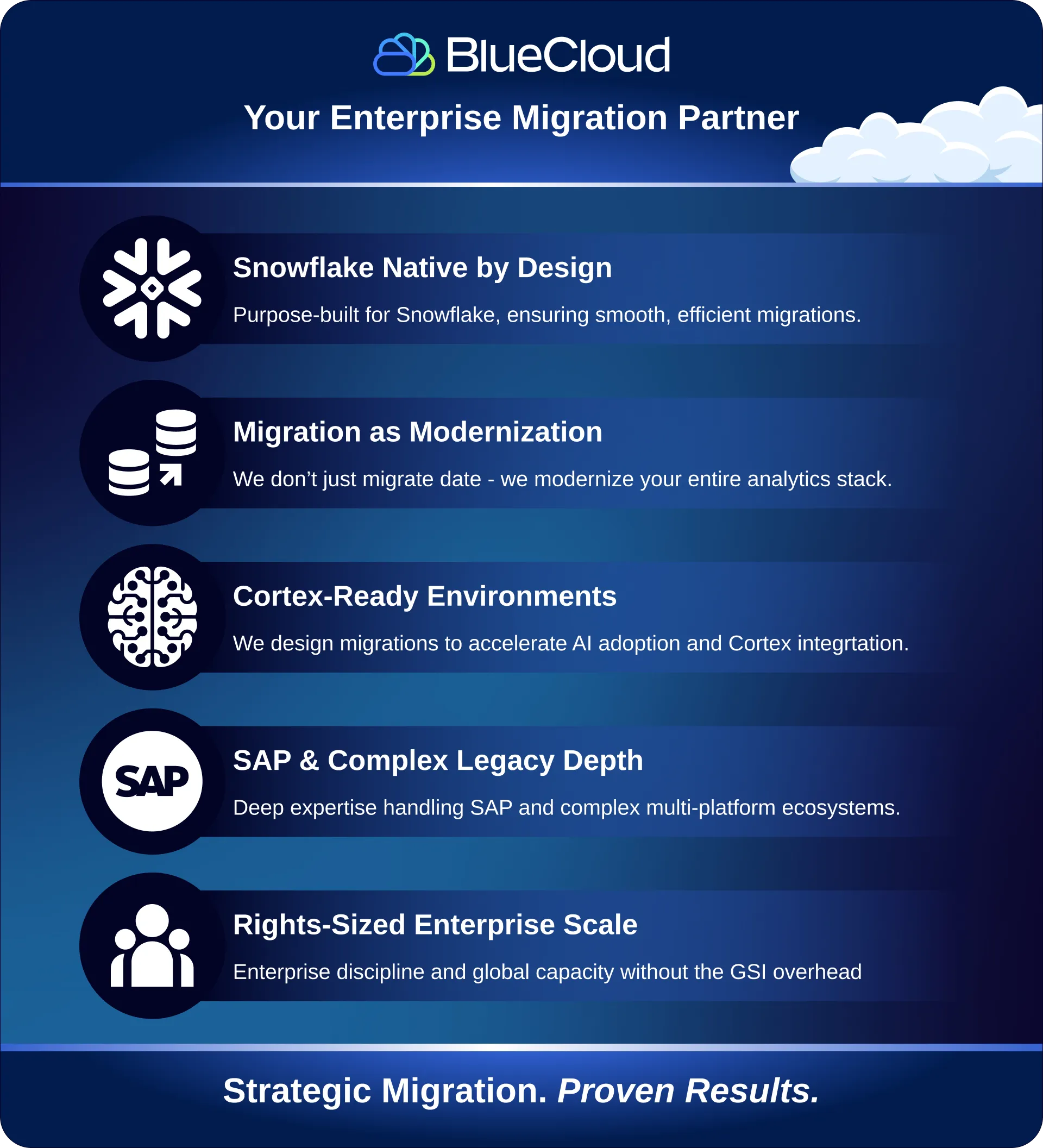
Preparing for a modern, AI-ready enterprise requires more than moving data. It demands strategy, discipline, and execution of excellence.
BlueCloud is evolving beyond traditional AI assistance into a fully integrated Human + Snowflake Cortex Code delivery model. Rather than treating AI as a standalone tool, BlueCloud embeds Snowflake Cortex Code directly into every engineer’s workflow. CoCo handles repetitive patterns while humans own architecture and critical decisions.
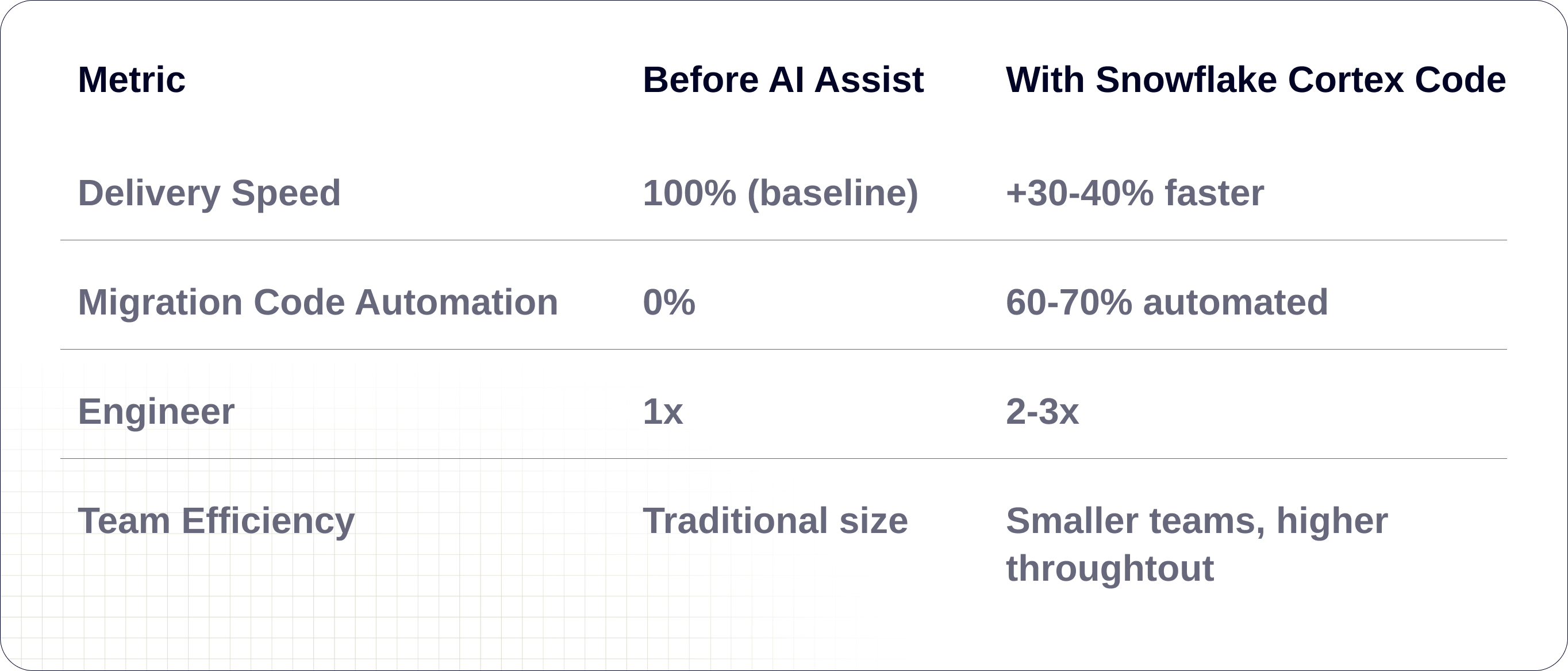
This is more than AI tooling. It’s a redefined, AI-accelerated delivery model built for scalable Snowflake modernization.
The right partner helps you rationalize your business intelligence, redesign your architecture, and reset governance, turning a complex migration into a foundation for scalable, future-ready Snowflake environments.
With real-world experience in SAP and complex legacy systems, BlueCloud keeps migrations on track even in high-stakes, multi-platform environments, delivering results without unnecessary overhead.
Ready to turn your migration into a strategic advantage and build a foundation for insights, AI, and growth? Let’s talk.