.svg)
%201.svg)
January 15, 2026
%201.svg)
Rob Sandberg
TL;DR
- SAP BDC Connect for Snowflake is an architectural shift, not just another connector. Zero-copy data sharing replaces batch ETL, making SAP data available in real time without duplication or extra pipelines.
- Governance stays at the source, not the target, and SAP business semantics carry over intact so data scientists and AI teams don't have to reverse-engineer SAP logic before building on it.
- Real-time access unlocks AI and ML use cases that batch loads simply cannot support: fraud detection, predictive maintenance, dynamic pricing, and supply chain forecasting.
- BlueCloud helps organizations go beyond connectivity — assessing whether BDC Connect, migration, or a hybrid model is the right fit, identifying high-impact AI use cases, and enriching SAP data with non-SAP sources to build unified, business-ready data products.
A Conversation with Rob Sandberg, SVP & Head of Advisory Services
SAP systems power core enterprise operations, yet much of their data remains underutilized. As demand for real-time analytics and AI grows, traditional SAP integration approaches are proving too slow and complex.
SAP BDC Connect for Snowflake represents a shift, from batch extraction and heavy migration to real-time, governed, AI-ready access.
In this conversation, Rob Sandberg, SVP & Head of Advisory Services at BlueCloud, explains why this shift matters now and how organizations can turn SAP–Snowflake connectivity into real business value.
Why SAP BDC Connect for Snowflake Is Different: From Integration to Architecture
What makes BDC Connect fundamentally different is that it is not simply another connector. It represents an architectural shift.
Traditional ETL pipelines, while effective in the past, are increasingly misaligned with modern data and AI needs. As organizations pursue AI chat, embedded AI, and automated decision-making, latency becomes a critical constraint.
“ETL isn’t necessarily legacy, but it’s a bottleneck for AI. Use cases such as fraud detection, predictive maintenance, dynamic pricing, and forecasting depend on live data exchange and not delayed snapshots. Most of these use cases require real-time data, and batch loads just don’t cut it.”
“SAP BDC Connect for Snowflake is based on zero-copy data sharing which is quickly becoming the standard for live data integration. It shows that SAP sees its partnership with Snowflake as truly strategic. If you want to run AI on SAP data, this isn’t optional anymore. You need it.”
Redefining Governance with Zero-Copy Data Sharing
As mentioned before, at the core of BDC Connect is zero-copy data sharing, a model that aligns directly with Snowflake’s core model around governance. Your data stays in SAP, but it’s accessible in Snowflake. Rather than creating multiple downstream copies and pipelines, governance remains centralized and consistent.
“There’s no extra copying, no new pipelines, no data lakes forming. Governance is controlled at the source rather than the target.”
This approach also enables continuous, bidirectional communication between SAP and Snowflake.
“Instead of a one-way pipeline and then reverse ETL, you get constant communication between the two platforms. The result is a simpler, more secure architecture that scales with enterprise needs while maintaining trust in the data.”
Powering Advanced Analytics, AI, and GenAI
SAP BDC Connect for Snowflake enables SAP data to be analytics- and AI-ready the moment it’s accessed in Snowflake. Without batch processing delays, organizations can move beyond historical analysis into real-time intelligence.
A key advantage is the preservation of SAP’s business semantics.
“Your data scientists or AI engineers don’t have to reverse engineer SAP logic. That logic already lives there.”
By combining SAP and Snowflake data models, organizations can establish a unified semantic layer that supports a wide range of use cases.
“You can attach BI use cases, chatbot AI, or AI agents on top of that semantic layer. SAP remains the source, and Snowflake becomes the intelligence layer. This foundation accelerates AI adoption while reducing complexity for technical teams.”
How BDC Connect Compares to Other SAP Integration Options
When compared to alternatives like SAP’s Databricks integration, SAP BDC Connect for Snowflake stands out in several key areas, particularly around flexibility, cost management, and architecture.
In terms of support, SAP is really the primary support provider for the Databricks option. With Snowflake, the solution is supported by SAP, but it’s also sold by SAP, which creates a slightly different dynamic.
“A lot of the feedback and complaints initially were around egress when it comes to Databricks.Snowflake addressed that by structuring payments outside the BDC capacity model. You can use BDC with either Databricks or Snowflake, but Snowflake removed that limitation through how credit consumption and payments are handled. This is one of the main differentiators.”
Snowflake has learned from what Databricks did earlier and improved on it. Snowflake credits, combined with the zero-copy architecture, are a real advantage for SAP customers choosing Snowflake over Databricks.
For organizations already invested in Snowflake, BDC Connect offers a path to real-time SAP analytics without compromising governance or cost control.
How BlueCloud Turns SAP–Snowflake Connectivity into Real Business Value
Connecting SAP to Snowflake is only the starting point. Real value comes from understanding how that connection supports business outcomes, optimizes costs, and enables new capabilities across analytics, AI, and data products. Rob outlines several key areas where BlueCloud helps organizations translate SAP–Snowflake connectivity into measurable impact.
Aligning Architecture to Business Goals
One of the biggest misconceptions organizations have is that technical connectivity alone delivers value. In reality, value emerges when data architecture decisions are directly tied to business objectives.
“BlueCloud works closely with clients to assess how SAP and Snowflake fit into their broader landscape. This includes evaluating whether BDC Connect is the right approach, whether migration makes more sense, or whether a hybrid model better supports the business.”
Driving Value Through Cost Optimization
Cost is a critical concern, especially for organizations already carrying large SAP investments.
BlueCloud helps reframe that view by showing how SAP–Snowflake connectivity creates incremental value, not incremental spend.
“We help demonstrate real gains by enabling AI and BI use cases that weren’t possible before. Whether running SAP as-is or migrating, BlueCloud helps clients align Snowflake to their cost model and deliver measurable ROI.”
Enabling Real-Time AI and Machine Learning
One of the most immediate sources of value comes from enabling real-time AI and machine learning use cases. Streaming SAP data into Snowflake removes the latency that traditionally limits advanced analytics.
“That’s really the cornerstone behind real-time fraud detection, forecasting, supply chain optimization, and predictive models in areas like healthcare and financial services.”
By eliminating batch delays, organizations can move from reactive reporting to proactive, automated decision-making.
Creating Scalable, High-Value Data Products
Another major value area lies in data products. SAP data is highly standardized across domains, which creates a strong foundation, but not differentiation on its own.
The real opportunity comes from taking SAP’s standardized data models and extending them with additional enterprise data already available in Snowflake.
“BlueCloud helps other companies answer questions like, “How can we enrich SAP data with non-SAP sources—Salesforce, Google Analytics, or other Snowflake data, and combine it into a new, unified data model?” By doing this, organizations can create richer, business-ready data products that provide deeper insights, connect previously siloed information, and unlock long-term value across analytics, AI, and operational decision-making.”
Taken together, BlueCloud’s approach to SAP–Snowflake connectivity focuses on more than just integration. It’s about making the right architectural decisions, optimizing cost and spend, enabling real-time AI, and building scalable data products that support long-term growth.
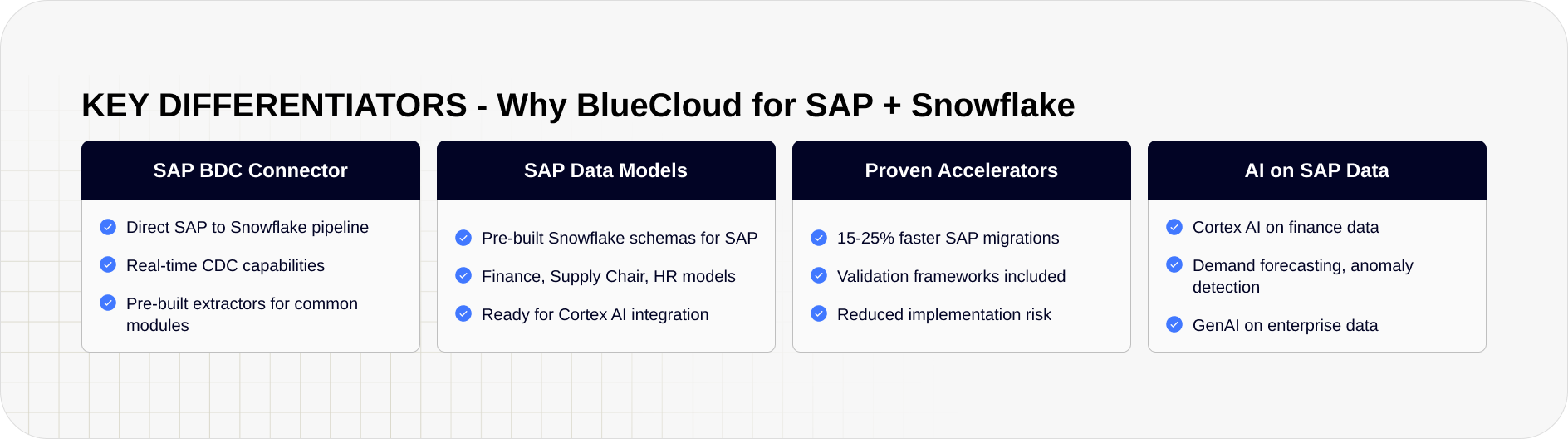
Make SAP–Snowflake Work for You
BDC Connect creates opportunity. However, realizing value requires the right strategy, architecture, and execution.
BlueCloud helps organizations assess where SAP–Snowflake connectivity fits into their landscape, identify high-impact AI and analytics use cases, and build scalable, cost-efficient data architectures that deliver results.
Ready to unlock real-time intelligence from your SAP data?

.png)
.png)