.svg)
%201.svg)
February 26, 2026
%201.svg)
TL;DR
- An estimated 220 billion lines of COBOL remain in active use worldwide, but mainframe systems are blocking real-time analytics, consuming 60-80% of IT budgets, and facing a talent cliff as COBOL expertise retires.
- Advances in large language models have made large-scale COBOL migration economically viable for the first time, reducing costs by 30-50% and compressing timelines from years to months.
- BlueCloud embeds Snowflake Cortex Code into every engineer's workflow, automating 60-70% of repetitive migration code and delivering 2-3x productivity gains while architects retain control of critical decisions.
- Mainframe migrations that once took 24-36 months now complete in 4-6 months with BlueCloud, producing a Snowflake architecture ready for analytics, AI, and long-term growth from day one.
Legacy systems rarely fail. They endure. But that endurance comes at a cost. Decades of embedded business logic sit buried inside opaque, rigid platforms never designed for modern analytics, cloud economics, or AI-driven operations, locking critical institutional intelligence inside systems built for a different era.
That reality is now changing. Breakthroughs in large language models, highlighted by advances from Anthropic, mean even the most complex COBOL mainframes can finally be understood, modernized, and migrated at scale.
This blog explores how AI is transforming the economics of legacy modernization, making large-scale COBOL migration viable for the first time, and why BlueCloud leads the way in moving mission-critical COBOL workloads to Snowflake.
Why COBOL Mainframes Are Holding Back Modern Business
For industries like banking, insurance, and financial services, COBOL still runs the business. An estimated 220 billion lines of COBOL code remain in active use worldwide, supporting nearly half of all banking systems and 95% of daily ATM transactions.
Built in the 1950s for scale, stability, and uptime, COBOL mainframes have endured because they work, reliably handling mission-critical workloads where trust and regulatory compliance are non-negotiable.
But that same strength is now a strategic constraint.
Operational Rigidity
COBOL mainframes are optimized for batch processing and rigid row-based data structures which makes real-time analytics, on-demand insights, and modern digital experiences extremely difficult.
Technical Debt
Mainframe systems can take up a large share of your IT budget. Licensing, specialized tools, and maintenance can consume 60–80% of spend just to keep operations running limiting investment in innovation.
Talent Shortage
Today’s developers are trained in languages like Python, Java, and SQL and not COBOL and JCL. Nearly one-third of available COBOL expertise is expected to retire by 2030, creating a talent cliff that threatens business continuity.
Data Silos
COBOL-based systems often keep important business data locked away, making it harder to connect with modern analytics tools, AI solutions, and cloud platforms, where speed and flexibility matter most.
For organizations focused on digital transformation, especially in high-regulation sectors like finance and insurance, the question is no longer if to modernize, but how to do it without disrupting operations.
AI Is Changing the Economics of Legacy Migration
The conversation around legacy modernization has fundamentally shifted.
Recent advances in large language models (LLMs), including high-profile announcements from Anthropic, have demonstrated that AI systems can now understand, reason over, and transform complex legacy codebases at a depth that was previously impossible.
This marks a turning point.
Where COBOL migrations once required years of manual reverse-engineering and massive engineering teams, AI now makes these transformations viable at scale, technically, economically, and operationally.
Industry research reinforces this shift:
- AI-driven modernization can reduce legacy migration costs by 30–50%
- Automation can compress timelines from multiple years to months
- Generative AI can surface undocumented business logic with far higher accuracy than manual analysis
- AI code assistants can analyze massive COBOL codebases, extract business rules, document logic, and even generate equivalent modern code structures.
- Generative AI tools shrink modernization timelines from years to months, or even quarters by automating repetitive and error-prone tasks
The outcome? Legacy modernization is no longer a high-risk but a strategic accelerator.
For financial institutions dependent on strict uptime, regulatory completeness, and auditability, AI unlocks deeper understanding of legacy systems and eliminates costly guesswork.
The Anthropic Effect: A Turning Point for Legacy Modernization
On February 23, 2026, Anthropic made headlines with a landmark capability: its Claude AI can now automate the exploration and analysis phases of legacy COBOL codebases.
Anthropic’s advancement shows that AI can now interpret, document, and surface the semantic intent behind legacy code at a depth and speed humans simply cannot match.
This is a signal that a long-standing barrier in enterprise transformation is finally coming down.
This shift is about value realization, not simply automation. Tasks that were once considered too risky, too slow, or too costly are now viable at scale, and enterprises can finally plan migrations as strategic transformations.
- Make the invisible visible – AI uncovers and documents critical business logic hidden inside legacy systems.
- Move faster – Modernization shifts from multi-year programs to short, predictable phases with clear progress.
- Reduce risk at scale – Automation cuts manual effort and errors while supporting large enterprise migrations.
- Unlock real value – Modernized systems fuel real-time analytics, AI use cases, and secure cloud platforms.
At BlueCloud, we leverage this new paradigm, applying AI not just to rewrite legacy code, but to preserve business value, accelerate migration timelines, and deliver modernization results that are predictable, measurable, and sustainable.
Why Snowflake Is the Strategic Data Cloud Target for Modernization
Modern enterprises need real-time analytics, scalable governance, and AI-ready architectures. Snowflake stands out as the ideal destination for mainframe modernization because it offers:
- True cloud-native scalability — Decoupled storage and compute deliver near-unlimited performance and flexibility.
- Unified data platform — Structured, semi-structured, and unstructured data in one place, without silos.
- Built-in AI readiness — Seamlessly powers analytics, ML, and GenAI without complex ETL.
- Enterprise-grade governance — Strong security, encryption, and compliance controls.
- Cost efficiency — Pay-as-you-go pricing with automatic scaling for full cost transparency.
How BlueCloud Modernizes COBOL: AI, Architecture, and the Human + Snowflake CoCo Model
COBOL modernization is the strategic reinvention of decades of institutional intelligence.
At BlueCloud, our approach to COBOL modernization is built on experience.
Across more than 200 enterprise data platform transformations, spanning Teradata, Oracle, SAP, SQL Server, and Redshift, we’ve seen the same pattern repeat: deeply embedded business rules, undocumented dependencies, aging infrastructure, and low tolerance for disruption.
What changes from project to project is not the migration pattern, but the complexity of the source system and the tooling required to modernize it safely.
Mainframe COBOL environments represent the highest end of that complexity. To solve it, BlueCloud brings three powerful capabilities together into one streamlined modernization model: the Human + CoCo delivery approach, advisory-led strategy, and our proven migration accelerators.
.webp)
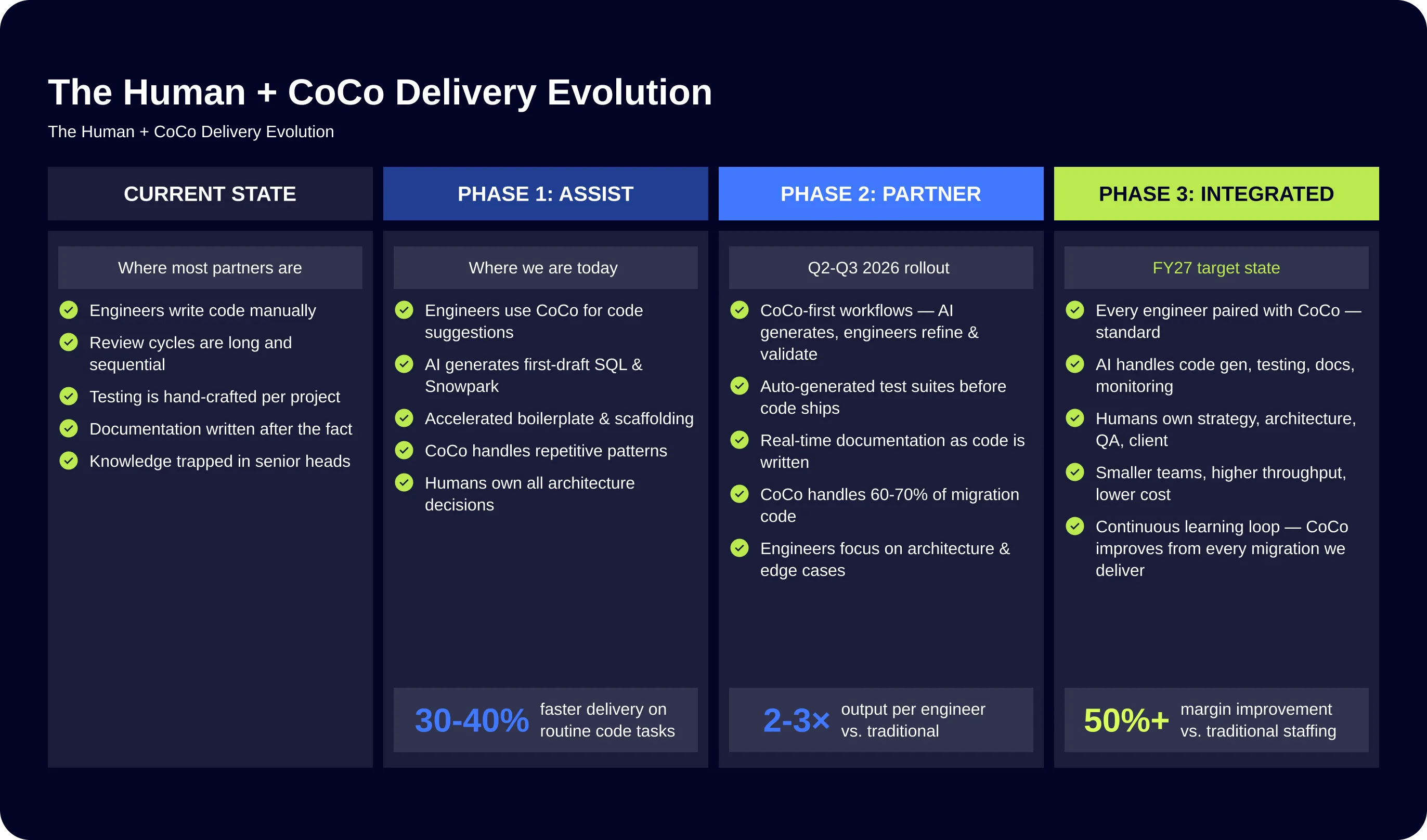
The Human + CoCo Delivery Evolution
BlueCloud does not treat Snowflake Cortex Code as a standalone tool. It is embedded into every engineer’s workflow as part of a defined delivery evolution.
In traditional models, engineers write code manually, review cycles are long and sequential, testing is handcrafted, and documentation is created after the fact. Knowledge often remains trapped in senior team members’ heads.
With the Human + CoCo model, this dynamics changes.
Assist Phase – Faster Starts, Lower Risk
From day one, AI accelerates SQL and Snowpark development by generating first-draft code and reducing repetitive engineering effort. Your teams benefit from faster early momentum while experienced engineers maintain full architectural control — ensuring quality, governance, and stability.
Partner Phase – 2–3× Productivity Gains
As CoCo-first workflows mature, AI generates migration code, automated testing, and live documentation in parallel.
- Up to 60–70% of repetitive migration code is automated
- Engineers focus on performance tuning, edge cases, and optimization
- Delivery productivity increases 2–3× compared to traditional models
For you, this means faster execution, lower delivery risk, and measurable cost efficiencies.
Integrated State – Maximum Throughput, Strategic Focus
In the fully integrated model, AI handles code generation, testing, documentation, and monitoring automatically, freeing engineers to focus on strategy, architecture, and critical decisions.
Your project benefits from:
- Smaller, highly specialized teams
- Faster time-to-value
- Continuous improvement across migration waves
- Margin efficiencies exceeding 50% versus labor-heavy legacy approaches
What once took over a year can now be compressed into structured AI-assisted cycles of 6–8 weeks for core translation phases. But the real shift is not just speed. It’s the way AI is embedded into delivery.
Advisory-Led Modernization — Strategy Before Code
At BlueCloud, every COBOL modernization engagement begins with our Advisory Consulting Workshop, a structured, executive-aligned approach designed to ensure measurable business impact before a single line of code is changed.
BlueCloud Migration Accelerators
Our Migration Accelerator Toolkit handles every step, from discovery and workload profiling to code conversion, data migration, validation, ETL modernization, BI rewiring, governance, and cutover, delivering predictable, secure, and compliant results.
The outcome?
Mainframe migrations that once took 24–36 months now finish in 4–6 months.
And rather than just replicating your legacy system, you get a modern Snowflake architecture ready for analytics, AI, and business-driving insights. Each migration unlocks massive Snowflake adoption, competitive advantage, and the foundation for broader AI and BI modernization.
From Legacy Constraint to Intelligent Growth with BlueCloud and Snowflake AI-Powered Cortex Code
Mainframe data is institutional intelligence.
AI, validated by breakthroughs like those highlighted by Anthropic, has made large-scale legacy migration economically viable for the first time.
BlueCloud makes it safe, structured, and successful.
Instead of simply replacing COBOL, organizations gain a Snowflake-powered platform ready for analytics, AI, automation, and long-term innovation.
AI makes these migrations viable at scale.
BlueCloud makes them real.
Ready to turn COBOL into a Snowflake-powered engine for growth?
Contact us to see how BlueCloud can make it happen.

.png)
.png)