October 22, 2026

TL;DR
- Snowflake AIM (AI-driven Modernization and Virtualization) is Snowflake's AI-powered platform for migrating, modernizing and virtualizing legacy data and code workloads on Snowflake. Snowflake introduced it in June 2026.
- Snowflake AIM automates much of the assessment, code conversion, testing and validation that used to require large engineering teams. Microsoft SQL Server and Amazon Redshift have full end-to-end coverage today.
- Snowflake AIM doesn't remove the need for expertise. Complex logic, data volumes, cutover planning and decisions about what to carry forward still need experienced people.
- The business value of Snowflake AIM comes after the move, when a faster migration frees time and budget for analytics and AI.
Moving to Snowflake has traditionally meant months of converting legacy code, fixing errors, testing workloads, and validating data. It's a complex process that requires significant time and engineering resources. But AI is changing that. Snowflake AIM brings together AI-powered tools to automate and accelerate key parts of the migration process, reducing manual effort and helping organizations modernize faster.
So, what exactly is Snowflake AIM? How does it work, and how much of the migration process can AI actually handle? This guide breaks down what AIM is, what it can and can't do, and what organizations should know before getting started.
What Is Snowflake AIM?
Snowflake AIM, short for AI-driven Modernization and Virtualization, is Snowflake's unified, AI-powered platform for migrating, modernizing and virtualizing enterprise data and code workloads on Snowflake. Built on SnowConvert AI, the Snowpark Migration Accelerator and Datometry, it brings assessment, conversion, testing, validation and data migration into one system. An AI migration agent guides teams across three modernization paths.
Data warehouse migration
Most enterprises start here, since the warehouse holds the logic the business runs on. AIM converts that logic into Snowflake-native form and brings SSIS and Informatica pipelines into dbt.
Spark modernization
Companies running Spark on platforms such as Databricks can use AIM to convert those workloads to Snowpark and consolidate them on Snowflake.
Teradata virtualization
For Teradata customers facing a renewal, virtualization lets existing applications run on Snowflake without being rewritten, so the company can exit on its own timeline. This path is currently in public preview.
One platform, used in phases
Many companies combine the paths, virtualizing Teradata workloads to exit quickly and modernizing them later. AIM runs inside Snowflake through Cortex Code, and Snowflake recommends the AIM migration agent as its preferred approach for modernizing onto Snowflake.
What Are the Components of Snowflake AIM?
AIM brings together four technologies. At its core is SnowConvert AI, which converts legacy code consistently and gives each program a dependable baseline. Cortex Code migration agents build on that baseline, resolving the issues conversion leaves behind and carrying each fix across the project. The Snowpark Migration Accelerator extends this approach to Spark, and Datometry virtualization lets Teradata applications run on Snowflake as they are. Together, they give the business results it can rely on and free engineers for the work that needs their judgment.
How Is Snowflake AIM Different from Traditional Data Warehouse Migration?
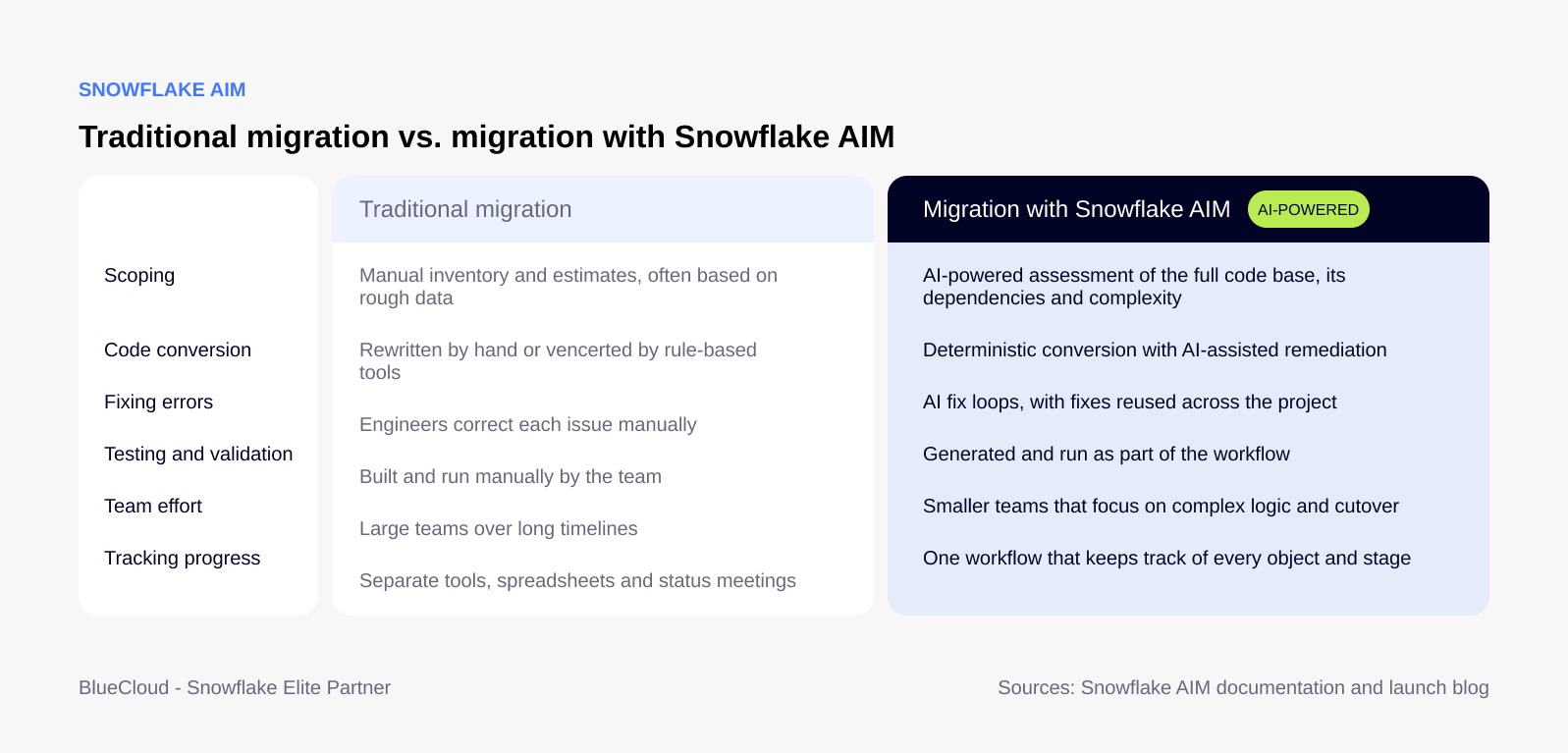
Snowflake AIM automates much of the conversion, testing and validation that traditional migrations left to engineers, and it runs the process as one guided lifecycle. A traditional program relies on people to fix code one object at a time. AIM resolves many errors automatically and shows upfront which objects need an expert.
What Are the Business Benefits of Snowflake AIM?
The most immediate benefit is faster time to value, with a smaller team than a manual migration would need. AIM also lowers the risk that has kept leaders cautious about migration. The assessment replaces rough estimates with a measured basis for timelines and budgets. Built-in testing and validation confirm that data and reports match the source before the new platform goes live, which protects business continuity. Companies can also retire the objects they no longer need instead of carrying them forward.
The result is a cleaner, AI-ready data foundation, which is where most of the return is realized. The capacity AIM frees can go toward data products designed for Snowflake, analytics the legacy platform couldn’t support, a single governed reporting layer and AI use cases on Snowflake Cortex AI.
Which Databases and Platforms Does Snowflake AIM Support?
AIM supports most major legacy data platforms, but the level of automation depends on the source. SQL Server and Amazon Redshift have the most complete coverage today. PostgreSQL, Teradata and Oracle are supported for code conversion and data migration. Platforms such as Azure Synapse, Google BigQuery and Netezza are supported for code conversion.
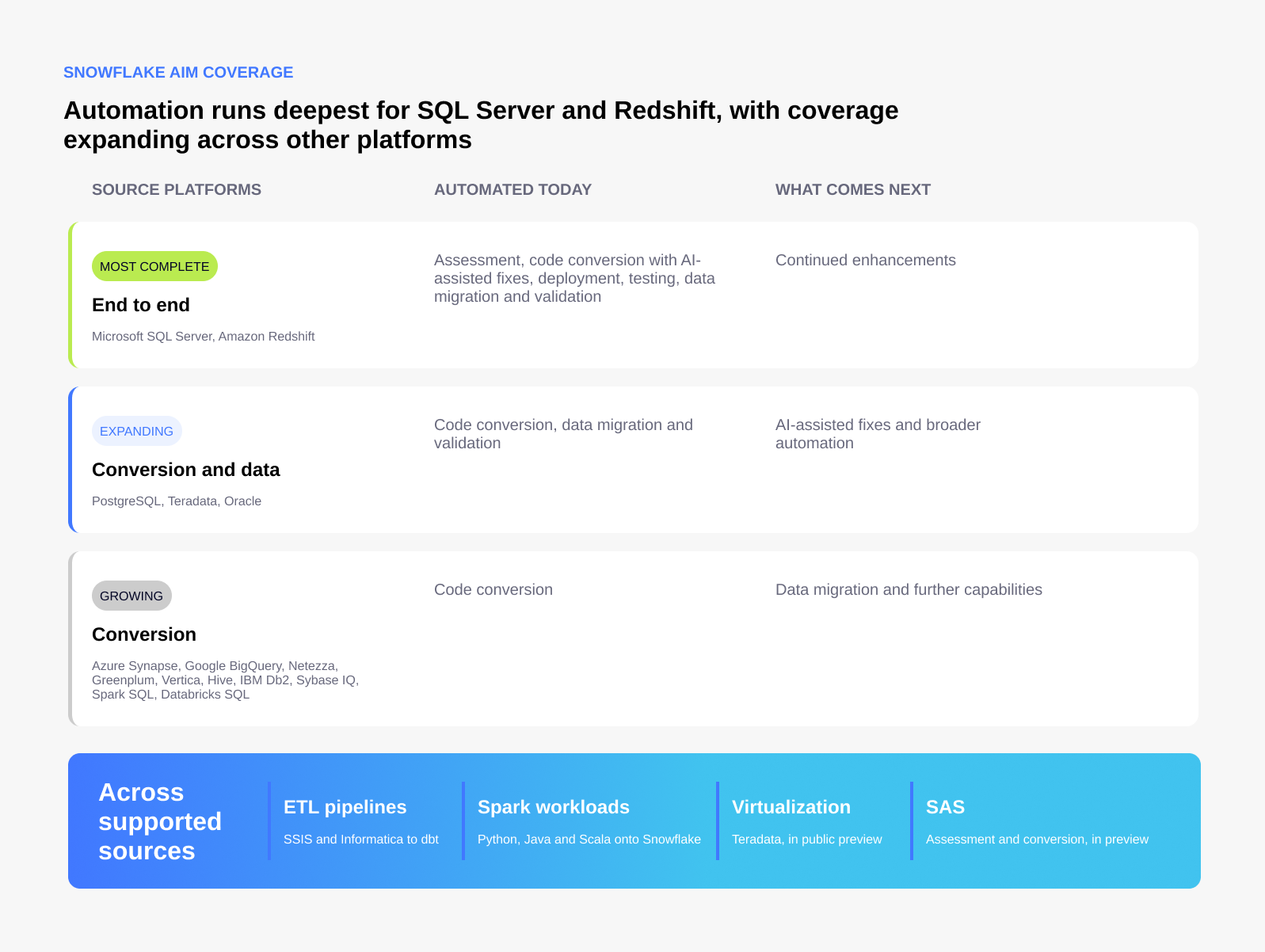
For other sources, leaders should plan for engineers to take on more of the testing and remediation from the start.
When Should a Company Use Snowflake AIM?
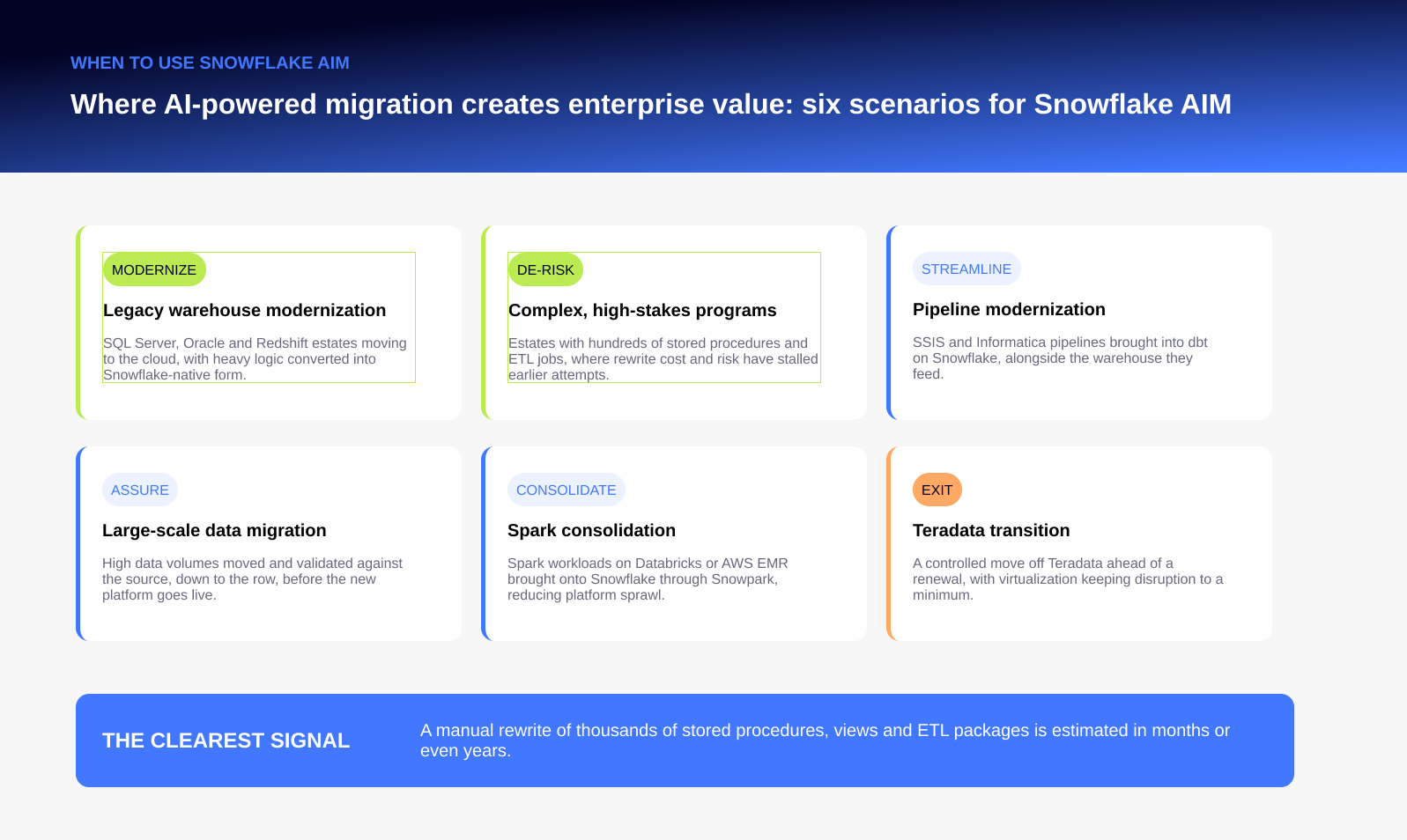
AIM delivers the most value when a large body of legacy code makes a manual rewrite too costly or risky to pursue. Such rewrites are often estimated in months or years. AIM also creates value for:
- companies modernizing ETL pipelines
- programs validating large data volumes before go-live
- teams consolidating Spark workloads
- Teradata customers who need a controlled exit ahead of a renewal
AIM offers less advantage to companies rebuilding from scratch. For everyone else, an assessment is the clearest way to establish the business case.
What Does a Snowflake AIM Assessment Include?
A Snowflake AIM assessment gives leaders a measured view of their legacy estate before they commit budget. It produces an interactive report covering scope and effort, inventory and dependencies, complexity and compatibility, modernization opportunities, risks and blockers, and sequencing. Together, these show how much work lies ahead and where experts will be needed.
The most valuable assessments, however, go further. Experienced architects interview stakeholders, review how the current platform performs and recommend a target architecture and roadmap. Within a few weeks, that turns a readiness check into an actionable plan. With a plan in place, the migration follows a defined workflow.
How Does Snowflake AIM Migration Work?
AIM guides a migration through six steps in Cortex Code, with an AI migration agent tracking progress and ownership along the way.
- Connect: a direct line to the source. The agent connects to the legacy database, the system of record.
- Initialize: a single source of truth. It creates one project that holds the code, decisions and progress.
- Register: complete visibility of scope. It brings every object into scope before work begins.
- Convert: less rework, more consistency. SnowConvert AI translates the code, and AI turns each fix into a rule that applies across the project.
- Assess: a clear view of effort and risk. The agent sequences the work into deployment waves and highlights logic that needs expert attention.
- Migrate: a switchover the business can trust. Objects are deployed in dependency order and data is moved. AIM then generates test cases and compares how the source and Snowflake behave. It also checks the data for completeness and accuracy, down to individual rows where needed.
New data continues to flow in through existing ingestion tools such as Fivetran. Even with this level of automation, part of the work still depends on people.
Can Snowflake AIM Fully Automate Migration?
Not entirely. AIM automates much of the routine work, but what remains often decides whether a program succeeds. Some of it is technical, since complex custom code may still need an engineer and large data volumes take time to move.
The bigger limits, however, are strategic. AIM can't decide which logic to keep, how to tune performance for new workloads or when to shut down the legacy platform. Those decisions shape the return on the migration, and experienced partners with deep knowledge of both the legacy estate and Snowflake help organizations make them with confidence.
How Much Does Snowflake AIM Cost?
AIM's code and data migration tooling carries no separate license fee. Companies pay for the Snowflake compute and storage the migration consumes, so cost scales with the size and complexity of the estate. Costs come from deploying objects, running AI fixes and loading data. Virtualization carries a separate license agreed with Snowflake.
From Snowflake Migration to Modernization: Accelerate Your Path to Enterprise Intelligence
Snowflake AIM can help organizations accelerate migration, reduce manual effort, and create a foundation for analytics and AI. But realizing that value starts with understanding your existing environment and building the right migration strategy.
BlueCloud combines deep Snowflake expertise, AI-powered migration capabilities, and Snowflake-native accelerators to help organizations assess their legacy environments, plan their migrations, and modernize with confidence.
Ready to explore what AIM could mean for your organization?
Book a migration readiness and roadmap assessment with BlueCloud.
FAQs
Is Snowflake AIM the same as Cortex Code?
No. Cortex Code is Snowflake's general-purpose AI coding agent. It helps with almost any development task, and the engineer decides each step. AIM's migration agent runs inside Cortex Code and adds the structure a migration needs: a guided workflow, progress tracked across sessions, and fixes that apply across the whole project.
Is Snowflake AIM the same as SnowConvert?
Not exactly. SnowConvert AI is the conversion engine at the heart of AIM, so teams that have used SnowConvert or the Snowpark Migration Accelerator will recognize parts of it. AIM adds AI-assisted remediation and brings those tools into one guided platform. Snowflake recommends it over the standalone tools for most programs.
Is my data secure during a Snowflake AIM migration?
Code conversion through Cortex Code runs locally. Migrated data lands in the company's own Snowflake account, under its existing governance and access controls. AIM also sets up role-based access as part of the migration, which helps teams answer the questions internal security reviews usually raise.
Does Snowflake AIM replace tools like Fivetran or dbt?
No. AIM moves the existing warehouse onto Snowflake and converts legacy ETL into dbt. Connectors such as Fivetran or Matillion are still needed to bring in new data from source systems. AIM works with dbt whether a team uses dbt on Snowflake or dbt Cloud.
What do teams need to get started with Snowflake AIM?
Teams need access to Cortex Code, a connection to their Snowflake account and network access to the source database. Most companies start with an assessment, which shows the scope of the work before anything is converted.