.svg)
%201.svg)
April 27, 2026
%201.svg)
Abirami Karthikeyan
TL;DR
As AI moves into production, the real difference is not query generation, but understanding the business context. Snowflake Cortex Code delivers semantic, context-aware, and enterprise-ready workflows, while Databricks Genie Code relies on metadata inference and remains workspace-bound.
The result: Cortex Code enables scalable, governed AI, while Genie Code limits real-world execution.
This blog is part two of a two-part series exploring the real-world differences between Cortex Code and Databricks Genie Code. In this second blog, we build on part one by focusing on business context, semantic understanding, and how these tools perform in real enterprise scenarios.
As organizations move from experimentation to real-world deployment, the comparison between Cortex Code and Databricks Genie Code becomes less about generating queries and more about understanding the business behind the data. Differences in context awareness, semantic modeling, and enterprise readiness begin to shape outcomes in more meaningful ways.
Cortex Code vs Genie Code: Does Your AI Agent Actually Understand Your Business?
Another question that becomes increasingly important as you move from experimentation to real-world use is this:
Is your platform simply querying data, or does it actually understand how your business defines it?
At first glance, both Genie Code and Cortex Code support text to SQL for generating insights. But how they arrive at those insights, and how reliable those results are depends entirely on the business context of their underlying semantic layer.
Genie Code is not fully context aware.
Genie Code does not rely on a traditional, explicitly defined semantic modeling layer. Instead of centrally governed business logic, it primarily infers context from metadata (e.g., table and column descriptions defined in Unity Catalog) and leverages built-in AI functions to interpret and generate queries. This can limit consistency, governance, and reuse compared to approaches with a well-defined semantic layer.
Cortex Code is fully context aware.
Cortex Code knows your Snowflake and data ecosystem so well that it can automatically resolve setup, networking, compute or access hurdles, while staying strictly within your defined security boundaries.
Cortex Code introduces a true semantic layer built on explicitly defined models.
These models are structured using YAML and include clearly defined dimensions, measures, and business logic. They are version-controlled, reusable, and aligned with how the organization actually understands its data.
This allows Cortex Code to move beyond interpretation and into understanding.
While both platforms can generate queries, only one is grounded in a consistent, governed understanding of the business.
So, What Is the Real Difference?
At this point, the answer becomes clear. This is not just Cortex Code vs Genie Code. It is:
- Workspace-bound assistance versus environment-aware execution
- Limited interaction versus extensible workflows
- Metadata-driven outputs versus semantic intelligence
- Incremental productivity versus end-to-end acceleration
While Genie Code is an improvement to the two-year Databricks Assistant, Cortex Code fundamentally changes the game in data + AI development
How Cortex Code Wins Over Genie Code
If you step back and really look at this comparison beyond features, interfaces, and positioning, a much bigger picture starts to emerge. It is about a shift in how development itself is evolving.
Genie Code, by design, remains tied to a workspace-centric model. It assumes that development happens inside a controlled environment, within notebooks, within a browser, and within predefined boundaries.
Cortex Code challenges that assumption entirely.
Cortex Code introduces a model where development is no longer constrained by a single environment or UI. It transforms building with Cortex Code by enabling artificial intelligence to not just assist in coding but actively execute, workflows that are orchestrated, automated, and deeply integrated into your AI and data pipelines. It is not simply improving productivity within an existing workflow. It is redefining what data pipelines and development workflows look like in the first place.
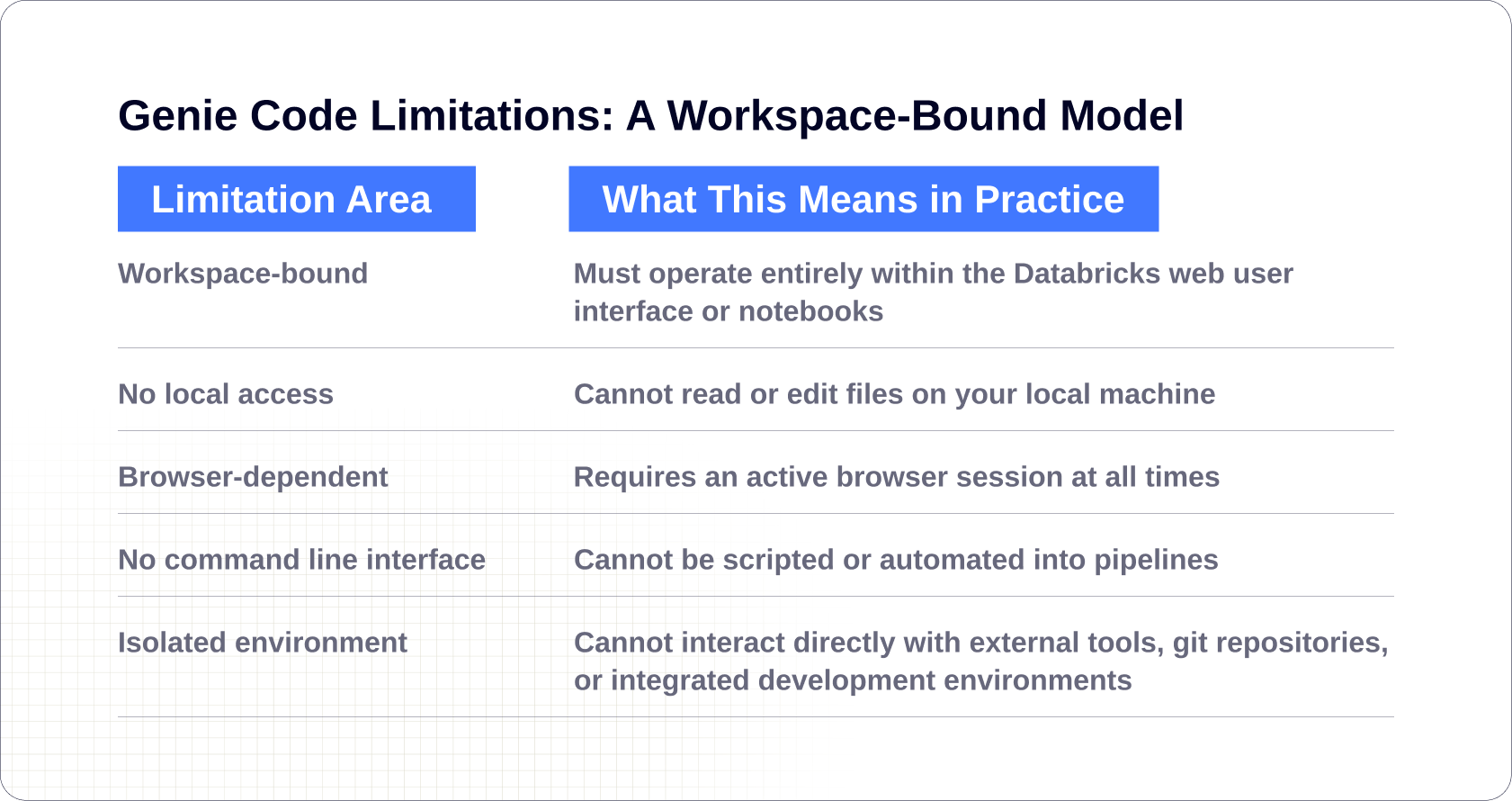
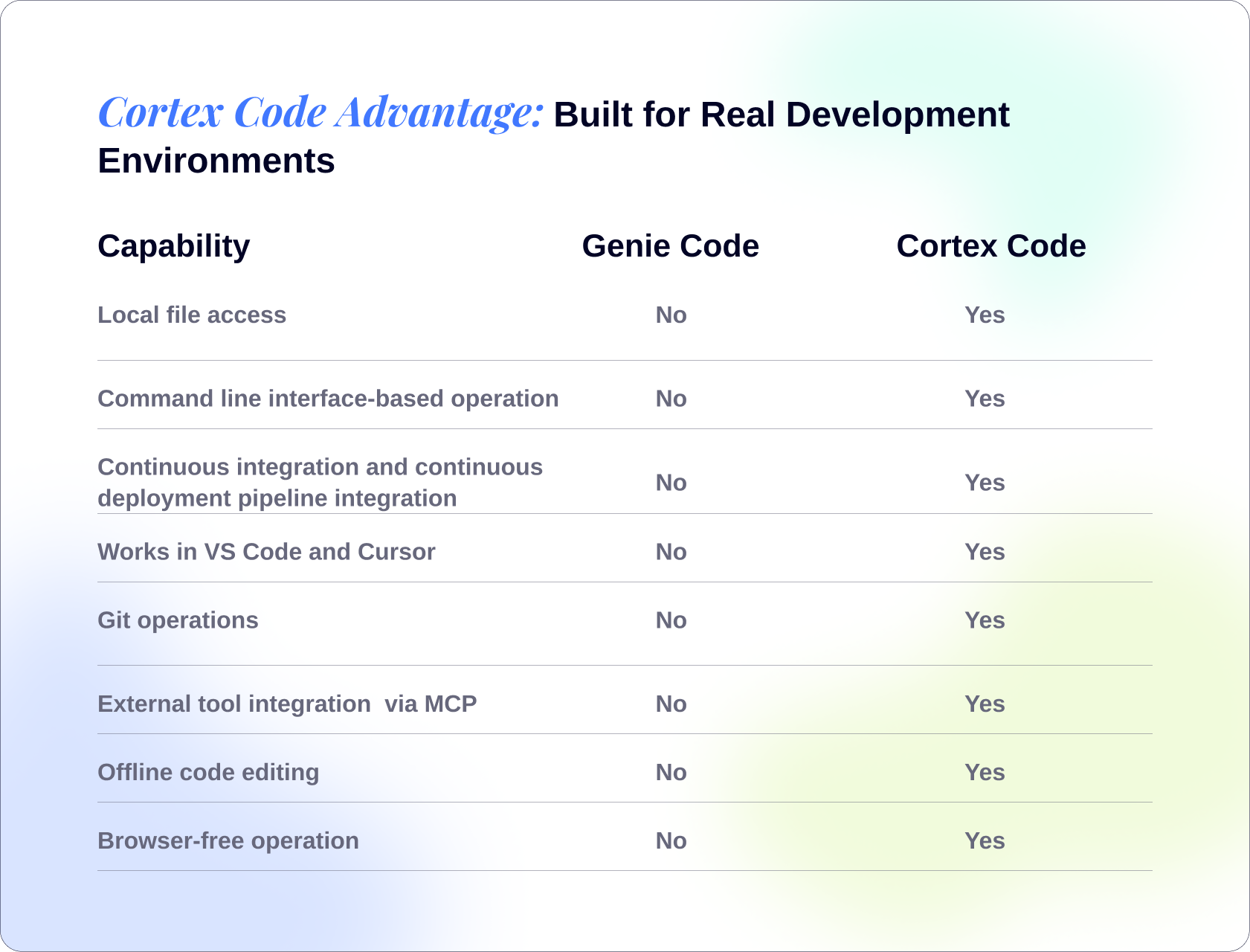
Cortex Code is aligned with how development already happens. It meets developers in their terminal, their integrated development environment, and their local environment, while still connecting seamlessly to Snowflake’s cloud capabilities.
And that is what makes it viable for real-world DevOps, automation, and enterprise workflows in a way Genie Code simply cannot support.
Where BlueCloud Comes In: Turning Cortex Code into Real Impact
Making the most of Cortex Code is not just about turning it on. It requires the right architecture, the right integration strategy, and a clear understanding of how to align it with your existing ecosystem.
And bridging that gap requires more than tools. It requires experience, structure, and the ability to connect strategy with execution.
At BlueCloud, we work closely with organizations to do exactly that.
From designing modern data platforms on Snowflake to implementing Cortex Code across teams, we help bring together data engineering, governance, and artificial intelligence into a unified, production-ready approach.
As a Snowflake Cortex Code Preferred Partner, we help organizations accelerate migrations, modernize legacy systems, and bring artificial intelligence use cases into production at scale, with less risk and greater speed.
Explore What This Looks Like in Practice
If you are looking to understand how Cortex Code can be applied in real-world scenarios, here are a few examples of how we are helping clients unlock its full potential:
- Global investment firm transformation with Cortex Code
https://www.blue.cloud/case-studies/global-investment-firm-cortex-code-ai-delivery-transformation
- Accelerating Snowflake migrations with artificial intelligence and Cortex Code
https://www.blue.cloud/blog-posts/ai-snowflake-migration-cortex-code-accelerate-delivery
- Modernizing mainframe systems with Cortex Code for COBOL to Snowflake migration
https://www.blue.cloud/blog-posts/accelerating-mainframe-modernization-with-ai-bluecloud-cortex-code-for-cobol-to-snowflake-migration
.png)