October 26, 2026

Harsha Vardhan joined BlueCloud in 2020, at the start of his IT career. In a field where many people treat their first job as a stepping stone, he took a different route: six years later, he's still here, growing into his role as a data engineer.
Today, Harsha builds and validates data pipelines on Snowflake for enterprise clients as part of BlueCloud's India team. Ask him what has kept him here for six years, and his answers point to the same three things: work he could own early, technology worth learning, and colleagues who helped him get better at both. We spoke with him about choosing BlueCloud for his first role, what ownership means to him, the healthcare project that taught him the most and where he wants to go next.
What made BlueCloud the right place to start your career?
Back in 2020, I was looking for a company built around data and cloud, and BlueCloud was the closest match to the work I wanted to do. It's where my career began. I remember thinking it was a place where I could grow and bring value in return.
If a client asked what you deliver for them, what would you say?
I'd say I deliver accurate data, built to their requirements and on time. That starts with understanding what they need before anything gets built. From there, the work is mostly SQL and Snowflake: I develop the transformations, write the stored procedures and test what moves through the pipelines until I know it's right.
You moved from data analysis into data engineering. How did that change your approach?
Data analysis and data engineering involve different responsibilities. Moving into engineering meant taking a more direct role in building the pipelines that prepare data for analysis. I now start with the business requirement and the source data and design the transformations from there.
It also changed how closely I look at the data. I now pay attention to how it differs from one system to the next, so it stays consistent and reliable for the analysis that follows.
What's the hardest part of your role, and what keeps it exciting?
It's usually not the code. Sometimes the technical solution is straightforward, but understanding the business requirement and handling the different data scenarios takes more effort.
What I find most exciting about the role is the scale and the variety of data I have to handle. I work with huge volumes from many different sources, and I'm free to explore new types and new technologies along the way.
Which project has taught you the most?
Looking back, it was the project we did for a healthcare client, and it's the one I enjoyed most, too. The sensitivity of the data made the work feel different. We were handling patient information such as age, conditions and medications. We also implemented hashing logic to keep the sensitive information secure, and working out how to do that was what I enjoyed most.
Another challenge was the variety of data. Several sources, each with its own structure and requirements, had to come together in a single flow, so I worked through the source-to-target mapping and built the transformation logic into the pipeline. When something didn't look right, I traced it back through the flow to find where the issue was.
Overall, it was a great learning experience, because it helped me understand the data engineering process end to end.
How has Snowflake changed the way you work?
It's made the work simpler and faster. With far less infrastructure to manage, we can give our attention to the data itself, and clients see the results sooner.
You joined BlueCloud looking for a place to grow. What has made that growth possible?
Culture comes first. For me, a good culture means open communication and collaboration, and that's what I've found here. Beyond that, I've been able to keep building my data engineering skills and, most importantly, to work independently and own my projects.
At first, I focused on getting my own task done. As I got more involved, I realized that ownership is more than finishing the assigned work. It means looking at the complete flow and taking responsibility for the final outcome.
How does your team support you?
We work in a hybrid setup, with a couple of days a week in the office, and I work closely with colleagues across time zones. We've worked well together on every project, and I always feel comfortable raising an issue, asking a question or sharing an idea.
Whenever a technical issue has held me up, my teammates and leads have made time to work through it with me. They never simply gave me the solution. They would take the time to understand what I was trying to do, and then help me find where it was going wrong.
That's how I learned to solve problems independently, and where much of my confidence comes from.
Six years in, what do you want to take on next?
I'd like to take on more responsibility and get more involved in the design side of data engineering. I also want to keep improving my Snowflake skills, especially around performance and building solutions that scale.
What fascinates me most is how AI is being built into every important tool, including the ones we already rely on, like Azure Data Factory. I want to understand how AI can be used in tools like Azure Data Factory to make our work more efficient and improve the way we build and manage data pipelines.
What would you tell a friend who is considering a career at BlueCloud?
I'd tell them the best thing about BlueCloud is the exposure you get. From the start, you work directly on modern cloud technology like Snowflake and AI, with people around you who step in whenever you need a hand. You learn fast that way, and your work goes straight into what we deliver for clients.
Grow with BlueCloud
At BlueCloud, our teams work on enterprise data, Snowflake and AI projects for organizations around the world, supported by colleagues who are committed to your success. Whether you're looking for your first role or for more ownership of your work, BlueCloud gives you room to learn, contribute and grow.
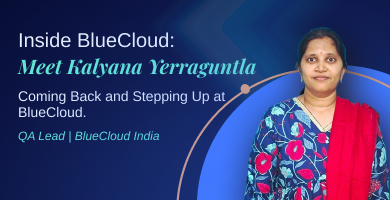
Meet more of the people behind BlueCloud: Gaurav Barde, on growing from data engineer toward solution architecture, and Kalyana Yerraguntla, on stepping up to lead her team.