November 17, 2026

Snowflake Expedition 2026: What's New and Why It Matters
TL;DR
- Snowflake Expedition 2026 introduced new tools to help companies move AI agents from small pilots into everyday, governed use.
- Snowflake Business Ontology gives AI agents one approved set of business definitions, and Cortex AI Gateway adds controls over what agents can access and what they cost.
- Snowflake CoCo automates more of the work of building and fixing data pipelines, and new streaming features bring real-time analytics onto one platform.
- Snowflake CoWork and CoCo will soon add Snowflake Bots, background agents that take on longer, goal-driven tasks and check in only when a human decision is needed.
What Is Snowflake Expedition 2026, and Who Is It For?
Snowflake Expedition is Snowflake's flagship global virtual event, where the company unveils new products and shows customers how to put data and AI to work. This year's edition ran November 3 to 6 across the Americas, EMEA and APJ. An evolution of Snowflake BUILD, it was free to attend and included dedicated tracks for technical, sales and marketing, and finance teams.
Most of this year's announcements focus on one challenge: getting AI out of experiments and into production, where people rely on it for real work. In this guide, we break down six of the most important announcements in plain terms: what each one is, what's new and why it matters for businesses.
The announcements fall into three themes:
- Trusted AI actions and outputs: AI that gives reliable answers and follows company rules.
- Scale intelligence efficiently: Running AI and data operations without excess cost or complexity.
- Build faster and work smarter: Automation that makes good work repeatable.
Trusted AI Actions and Outputs
Snowflake Business Ontology: Giving AI a Shared Understanding of the Business
Ask three departments for net revenue and you may get three defensible answers. An AI agent will repeat whichever one it finds.
An ontology is an agreed set of definitions: what each business term means, how it relates to other terms and the rules for using it. Snowflake Business Ontology, part of Snowflake Horizon Catalog (Snowflake’s governance and discovery layer), lets organizations set those definitions once and serve only approved versions to AI agents. Each definition has an accountable owner and a logged history of every change, and it works alongside the Semantic Views that calculate it. Teams can bring in existing definitions through a guided CoCo session. Business Ontology is expected in public preview soon.
Why it matters
Many businesses already use Semantic Views to describe how a metric is calculated from the underlying data. Business Ontology adds the meaning and rules behind those calculations. Together, they help agents and teams work from consistent definitions, reducing conflicting answers and reporting discrepancies.
Snowflake Cortex AI Gateway: Bringing Governance and Cost Control to AI Agents
A gateway is a single checkpoint that traffic passes through. Snowflake Cortex AI Gateway, now available as part of Snowflake Horizon Catalog, is that checkpoint for AI agents: it manages how agents reach models, tools and data across clouds and AI providers.
It applies an organization's existing access policies to agent requests, shows which models and tools agents use, and tracks AI spending, with the option to set hard limits. Cortex AI Gateway Tools checks tool calls before they run, including calls to MCP servers. (MCP, or Model Context Protocol, is a common standard for connecting AI agents to outside tools and data.) Dynamic Model Routing, now in private preview, sends each request to an approved model based on cost, accuracy and speed.
Why it matters
Security, visibility and unpredictable costs are among the biggest reasons AI agents stall before production. Cortex AI Gateway puts those controls in one place, so leaders can see what agents are doing, what they cost and whether they're following policy.
Scale Intelligence Efficiently
Autonomous Data Engineering: Pipelines That Help Build, Monitor and Repair Themselves
Data pipelines are the automated processes that move data from source systems into Snowflake and prepare it for use. Building and maintaining them takes a lot of engineering time. Snowflake CoCo, Snowflake's AI coding agent, now takes on more of that work, while engineers still approve what reaches production:
- Building pipelines in plain language: CoCo builds pipelines from plain-language requests, and CoCo Automations schedules recurring checks.
- Built-in orchestration: Snowflake Pipeline Builder lets teams arrange pipeline steps visually, and CoCo Cloud Agents can keep working in the background.
- AI-assisted troubleshooting: Agents spot issues and propose fixes, then route them to engineers for approval through Snowflake for Slack and the CoCo GitHub Integration.
Why it matters
Building and maintaining pipelines takes significant engineering time. Automating routine development, monitoring and troubleshooting reduces that workload, giving data teams more time to develop new analytics, data products and AI applications.
End-to-End Real-Time Analytics: Simplifying Real-Time Data Architectures
Most analytics still runs on data loaded in batches, often once a day. Real-time analytics works with data as it's created. Snowflake now handles every step of that on one platform:
- Snowpipe Streaming with Elastic Channels brings data in as it's created and scales automatically.
- Snowflake Datastream gives Apache Kafka users a direct route into Snowflake. (Kafka is a widely used system for moving streams of data between applications.)
- Streaming Transformations clean and prepare data as it arrives.
- Interactive Analytics delivers near-instant answers to dashboards, applications and AI agents.
Why it matters
For decisions about pricing, inventory, fraud or customer experience, yesterday's data can already be out of date. Running the whole real-time path in one place means fresher answers and fewer separate tools to manage. Cboe Global Markets, for example, now brings almost 200 billion rows of market data into Snowflake each day and can query it within seconds or minutes, where its teams once waited for an end-of-day batch.
Build Faster and Work Smarter
Snowflake CoWork: AI That Understands the Business and Remembers Context
Snowflake CoWork is a personal work agent for business users. It lets teams ask questions in plain language and act on their company's governed data. Expedition added features that help it understand the business and remember each user:
- Cortex Sense grounds answers in business context, giving priority to approved Business Ontology definitions.
- User Memory carries context and decisions from one session to the next.
- CoWork Profiles give each team role-specific agents, skills and instructions.
- Snowflake Dashboards and Snowflake Mobile bring conversational analysis and approvals to more devices.
Why it matters
The right answer often depends on context: who's asking, what they asked before and which definition applies. These features give CoWork that context, so business teams get consistent answers without re-explaining their role or their metrics every time.
Snowflake CoCo: Making AI-Powered Development More Repeatable
Snowflake CoCo is an AI coding agent for developers and data teams. New features help teams reuse what already works:
- Automations run proven workflows on a schedule.
- Reusable skills and a plugin catalog let teams share what works. A skill is a saved set of instructions CoCo can follow, and administrators can certify official ones.
- Memory and Profiles carry past decisions and role-specific context across sessions.
- Snowflake Bots, coming soon, will take on longer, goal-driven tasks and check in with users when a decision is needed.
Why it matters
A good solution no longer has to stay with the person who built it. Shared, certified skills make proven approaches repeatable across teams, so no one starts from scratch.
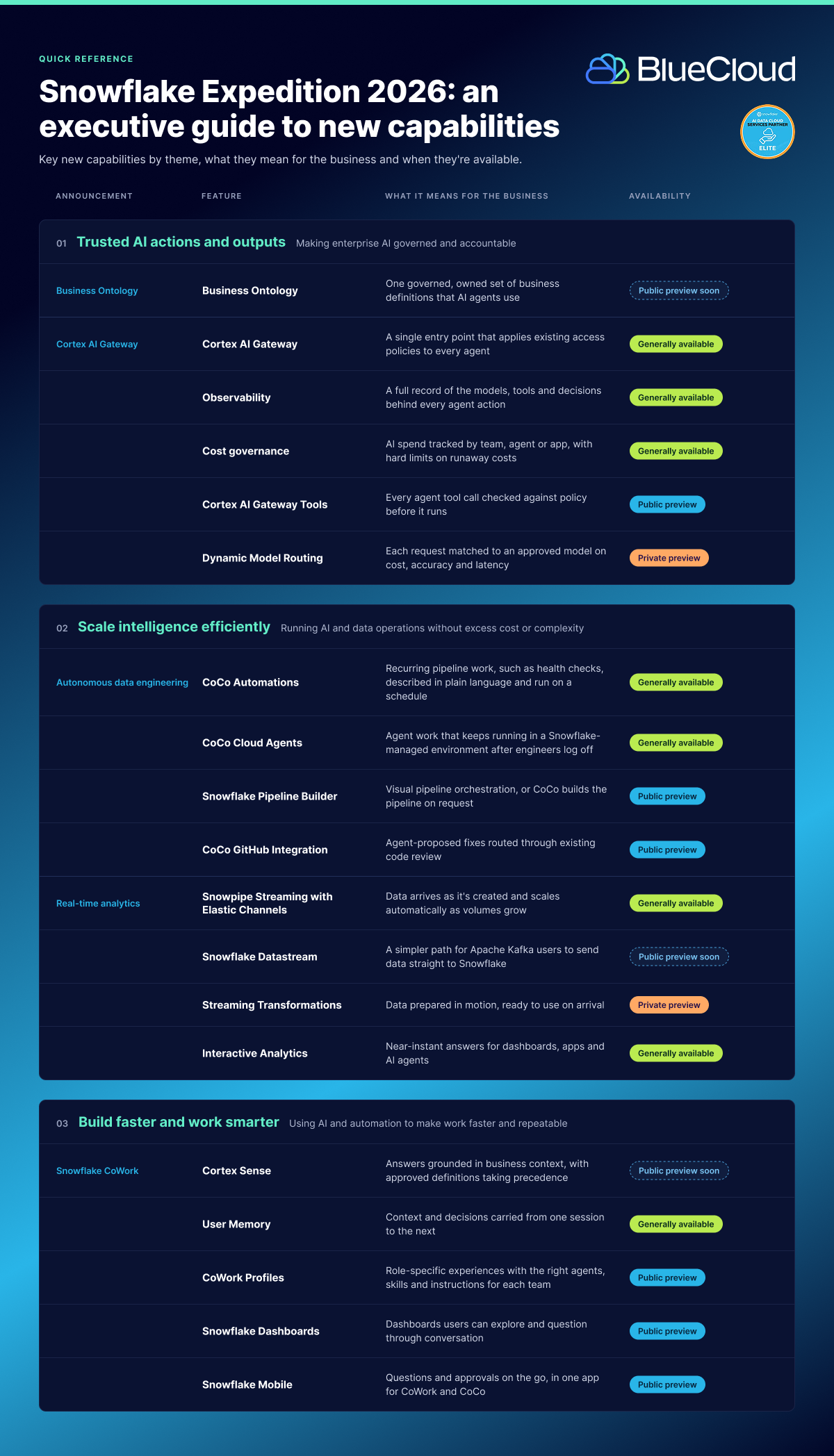
Snowflake Expedition 2026 at a Glance
Here's a quick reference to the key features by theme, and where each one stood at announcement.
What Does Snowflake Expedition 2026 Mean for Enterprise AI Strategy?
Taken together, the announcements point to a shift from experimenting with individual AI tools to running AI that organizations can govern, scale and use every day. Three priorities stand out:
- Establish trusted business context. Consistent definitions, governed data and clear access policies help AI agents give reliable answers.
- Simplify and automate data operations. AI-assisted engineering and real-time analytics reduce manual work and make current data easier to use.
- Make AI repeatable. Shared skills, memory and reusable workflows help successful AI use cases spread across teams.
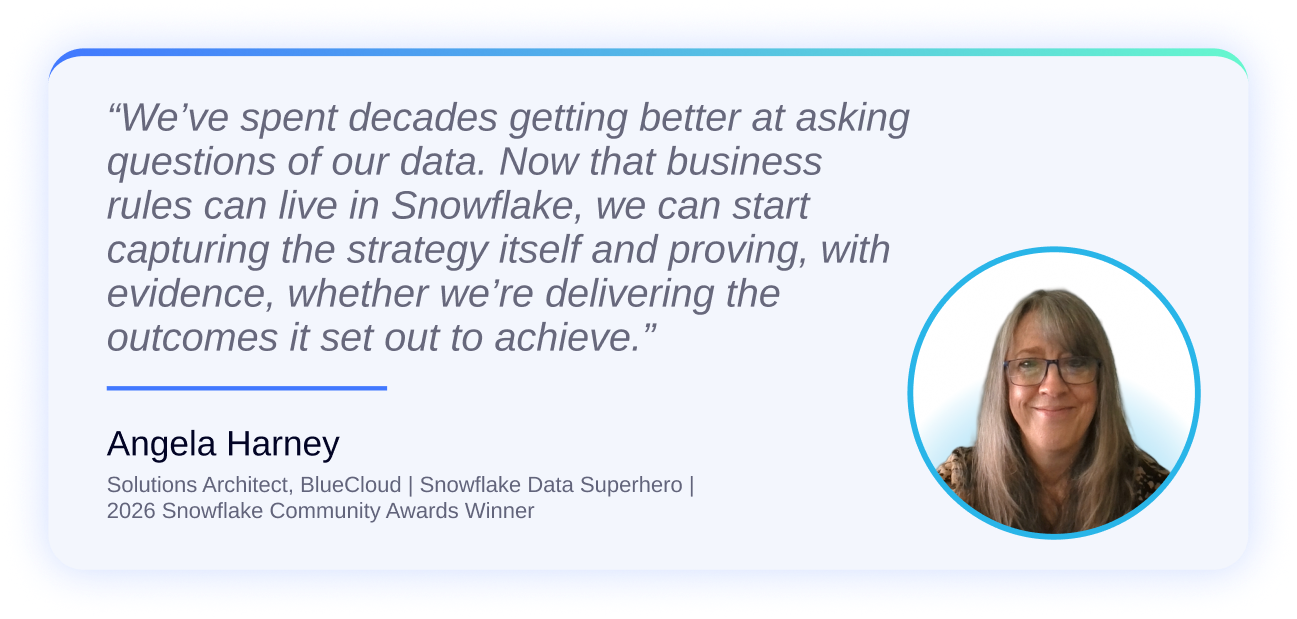
Angela Harney, BlueCloud solutions architect, Snowflake Data Superhero and winner of a 2026 Snowflake Community Award for AI Excellence, sees the next opportunity in moving from answering business questions to measuring progress against business goals. An agent can already suggest how to grow Q3 sales, but leaders need to know what that growth is for. "Are you trying to sell the company?" she asks. She calls this an "evidence-based outcome strategy," in which organizations connect their data and analytics to the results they're trying to achieve.
Seize the Data: Go from AI Experiments to Production
Every capability covered here depends on the same foundation: governed data connected to the business context that gives it meaning. As a Snowflake Elite Partner and 2026 Snowflake CoCo Catalyst Partner of the Year, BlueCloud helps enterprises build that foundation and turn new Snowflake capabilities into practical business results, from governed business context and modern data platforms to production-ready AI applications.
Our Enterprise Knowledge Layer connects and contextualizes enterprise data so people and AI work from the same understanding of the business.
Ready to put Snowflake's latest capabilities to work? Contact BlueCloud to schedule an Innovation Workshop.
Frequently Asked Questions
What is Snowflake Expedition 2026?
Snowflake Expedition 2026 was Snowflake's free global virtual event, held November 3 to 6, 2026, across the Americas, EMEA and APJ. It evolved from Snowflake BUILD and featured new product announcements focused on data, analytics and AI.
What is the difference between Snowflake Business Ontology and Semantic Views?
Business Ontology defines what a business term means, who owns it and the rules for using it. Semantic Views define how that term is calculated from the underlying data. AI agents use both to interpret questions and give consistent answers.
Which Snowflake Expedition 2026 features are available now?Generally available features include CoCo Automations, CoCo Cloud Agents, Snowpipe Streaming with Elastic Channels, Interactive Analytics, User Memory, and Skills and Plugins Sharing. Cortex AI Gateway is now available, Business Ontology is expected in public preview soon, Dynamic Model Routing is in private preview, and Snowflake Bots are coming soon.
What's the difference between Snowflake CoWork and Snowflake CoCo?
CoWork is for business users who want to analyze data, answer questions and complete tasks. CoCo is an AI coding agent for developers and data teams who build solutions, automate workflows and manage technical work.
Why does business context matter for enterprise AI agents?
AI agents act on whatever data and definitions they find. Without governed business context, two agents can give different answers to the same question. BlueCloud helps enterprises build that context in Snowflake so agents deliver consistent, trusted results.
How does BlueCloud help companies use Snowflake Expedition 2026 releases?
BlueCloud helps enterprises move new Snowflake releases into production, starting with the business problem. Its Snowflake experts define governed business context, help configure governance controls such as Cortex AI Gateway, and build CoCo workflows with Snowflake-native accelerators.