Key Takeaways
Enterprise AI starts with the problem, not the agent. For Joon Yoo, getting from possibility to production means understanding the objective, giving AI the right data and context, knowing where the technology breaks, and engineering for the realities of the enterprise.
For BlueCloud AI/ML Architect Joon Yoo, building enterprise AI starts with a deceptively simple principle: learn the limits of your tools.
Joon Yoo thinks AI engineers could learn something from professional drivers. A casual driver knows how to operate a car; a professional knows its limits: how the machine responds under pressure, how far it can be pushed, and what happens when those limits are exceeded.
Engineers building with AI, Joon argues, need to understand their tools the same way. “Like in any engineering, learn the limits of your tools,” he says. They need to know “what their tools are capable of, when it breaks and how it breaks,” and then how to build around those limits.
It’s a useful counterpoint to much of the conversation around agentic AI, which tends to focus on expanding capabilities: what agents can reason through, automate and accomplish next. Joon's work at BlueCloud is on the other side: making that capability perform inside real enterprises, with real data and real stakes.
His career spans banking, BI, cloud, and machine learning to agentic AI, plus teaching agentic systems at UC San Diego, all guided by one instinct: understand a technology deeply, then find what problem it solves. "Most importantly," he says, "you just want to solve problems."
Start with the Objective, not the Agent
As enterprises look for opportunities to deploy agents, Joon starts with a seemingly simple question: What are we actually trying to accomplish?
If you need to perform a calculation, use a calculator or conventional code. Introducing a large language model adds variability to a problem that already has a reliable answer.
The opportunity changes when reasoning enters the equation. Joon points to competitive intelligence: pulling a reported growth figure from a structured dataset is deterministic; conventional technology can handle it well. Finding signals in thousands of sales-call reports is different: the system has to determine what matters, then reason over what it means.
"Wherever you want some kind of reason step, that's where you want to bring in large language models," Joon says.
This changes the starting point for an AI initiative: instead of asking where an agent can be deployed, start with the business objective and whether AI creates enough value to justify using it.
The Demo Is Only the Beginning
Once an agent leaves the demo environment, knowing its limits matters even more. Getting a compelling answeronce is impressive, building a system that can produce dependable, grounded results repeatedly is a different engineering problem.
"It's always, 'Oh, it seems it answers the question really well,'" Joon explains. That may be enough for a demo. The harder challenge is making sure that same question gets a reliable answer tomorrow, too.
"That's where the productionization step comes in," he says. "Much harder to do."
Part of that challenge is data and context surrounding the model: a system built for human analysts isn't automatically ready for AI agents. People pick up company language and assumptions over time. An AI system needs that knowledge made explicit.
Joon uses the term "token tax" to describe the inefficiency that results when an agent must repeatedly work through context the organization could have provided more clearly. "If you have a gold layer, a semantic layer, that's great for a BI human being to build dashboards," he says. "But it's not the best for agents, not the best for AI."
The implication goes beyond giving a model access to more information. More data isn’t necessarily better data for AI if the context isn’t relevant, structured or controlled. As organizations prepare for agentic AI, the question becomes not simply whether an agent can access enterprise data, but whether it has the business context it needs to reason over that data accurately and efficiently.
Capability Isn't the Same as Value
The same discipline applies when deciding what to automate. An agent may be technically capable of doing a job and still be the wrong business choice.
Joon points to a friend's startup that still relies on customer-service reps based in the Philippines, not because agents can't do the job, but because the token cost of running an agent on that workload is higher than paying an offshore team to do it. He offers a personal example, too: he left a gastroenterologist's practice after it switched to an AI receptionist that he didn't like dealing with.
Neither is an argument against automation. Both point to a higher bar: whether AI can perform the task with the reliability, economics and experience needed to produce a better outcome.
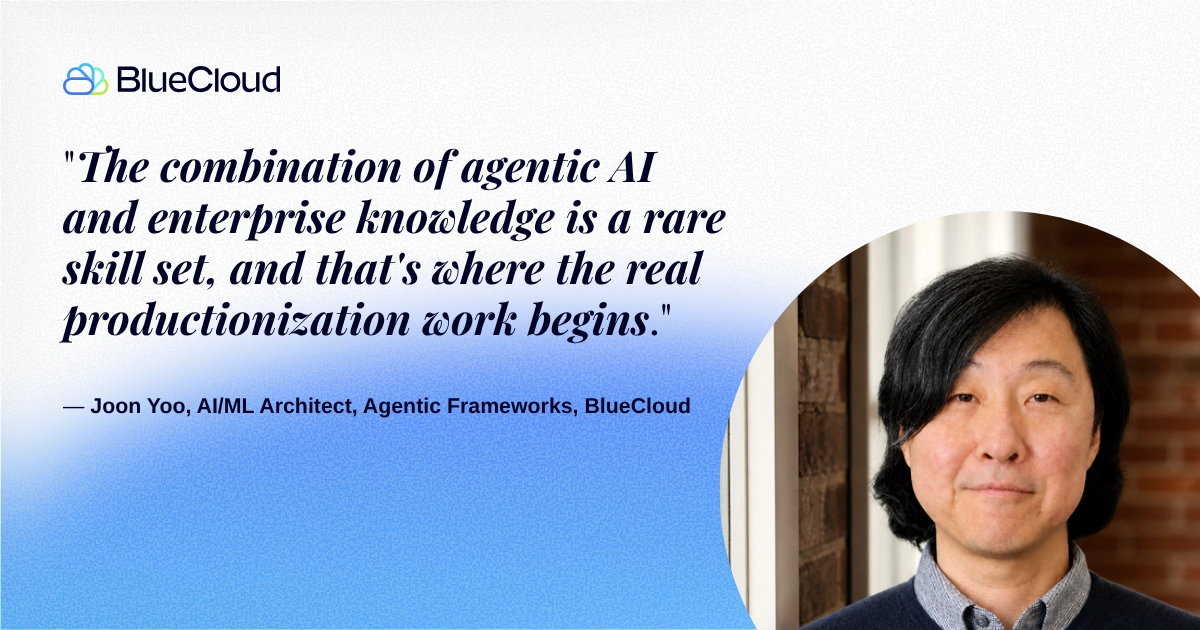
That kind of judgment is also why Joon believes one of the scarcer capabilities in AI today isn’t exposure to the technology itself. Courses, tutorials, and increasingly accessible tools can teach people how models work. Far harder to find are people who have built AI systems within the realities of an enterprise, where PII, permissions, security, governance and regional data requirements are part of the engineering problem. "The combination of agentic with enterprise knowledge is actually a very, very rare skill set," he says.
What Enterprise AI Actually Requires
Joon's approach strongly suggests that enterprise AI succeeds on four things: a clear business objective, data with the right context, a realistic view of where the technology fails, and an enterprise built to run it securely at scale. For Joon, it's not about using AI for its own sake, but about combining data and AI to solve a problem worth solving.
That intersection is also where Joon sees a natural role for BlueCloud. As organizations move from experimenting with AI to operationalizing it, the challenge increasingly spans disciplines that have often been treated separately. The business problem, the data foundation, the AI architecture, and the realities of enterprise execution all have to connect.
BlueCloud’s work modernizing enterprise data on Snowflake provides an important foundation for that next step. As Snowflake continues to bring enterprise data and AI closer together, organizations have an opportunity to move beyond simply making data available for reporting and analytics and begin preparing it for a new generation of intelligent applications and agents.
Doing that well requires more than adding a model on top. It means understanding the objective, preparing the data and business context, choosing the right technology for the problem, and engineering around the security, governance, and operational requirements of the enterprise.
For Joon, that is where the promise of agentic AI becomes much more practical: not AI for its own sake, but data and AI working together to solve a problem worth solving.
He sees the same philosophy in surfing: "Ninety-nine percent of surfing is…paddling and waiting." You learn to read the ocean and recognize that waves arrive in sets, so instead of chasing each one, you let it pass and position yourself for the next.
There will always be another model, framework or capability worth watching. Joon’s approach is to understand the conditions, know the limits of the tools in front of him, and recognize where they can create genuine value. Then be ready when the right opportunity comes.
Turn Your Data Foundation into an AI Advantage
Successful enterprise AI starts well before the model. It starts with a clear business objective, trusted data and context, a realistic view of what AI can do, and an enterprise foundation that can support it securely in production.
BlueCloud brings those pieces together on Snowflake, helping organizations modernize and prepare their data, identify where AI can create meaningful business value, and build production-ready solutions designed for the realities of the enterprise.
Through a BlueCloud AI Discovery Workshop, we work with your team to clarify the business objective, assess your data and AI readiness, prioritize high-value use cases, and define a practical path from opportunity to production on Snowflake.
Explore an AI Discovery Workshop with BlueCloud