November 23, 2026

Key Takeaways
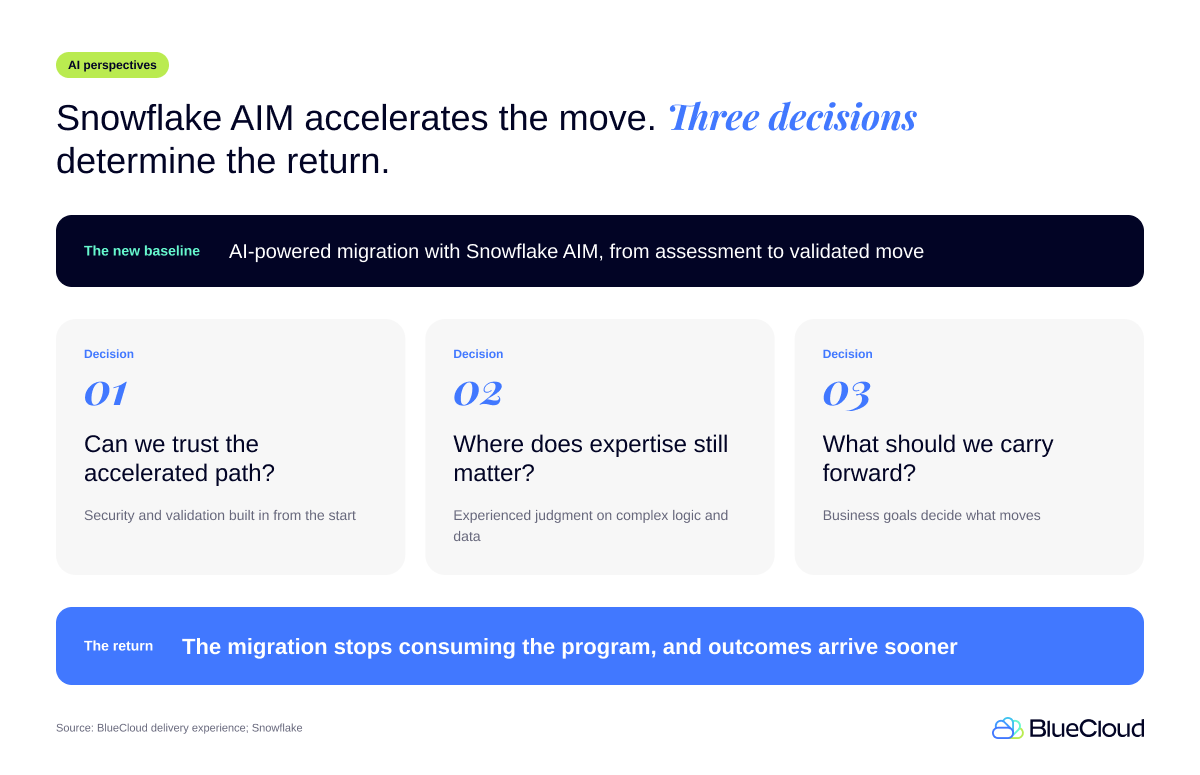
AI-powered migration is changing the economics of moving to Snowflake, but speed alone doesn’t guarantee a better result. For Abirami Karthikeyan, Director of Data Analytics at BlueCloud, the return depends on three decisions: whether to trust the accelerated path, where expertise still matters, and what deserves to move. Get those right, and migration stops consuming the program, so the outcomes the business has been waiting for arrive sooner.
For BlueCloud Director of Data Analytics Abirami Karthikeyan, getting value from AI-powered migration starts with knowing where automation ends.
When Abirami’s team migrated a large investment management firm’s Oracle platform to Snowflake in 2024, the conversion tooling was still rule-based, and engineers had to test and fix much of the output by hand. “We had to do a lot of human intervention,” she recalls. Her perspective comes from leading migrations onto Snowflake, from rule-based conversion in 2024 to AI-powered migration today.
It was a familiar pattern. Even as more enterprises build their data and AI strategies on Snowflake, the journey off legacy platforms remains the longest stretch of the road. Rewrite estimates stretch into years, and timelines bend around contract renewals and security reviews. Too often, the budget set aside for analytics and AI is gone before the business sees any return.
That’s beginning to change. With Snowflake AIM, Snowflake has brought AI to the migration itself. SnowConvert AI, the conversion engine at its core, makes code conversion and testing two to three times faster, according to Snowflake. But speed on its own doesn’t guarantee a better result. In Abirami’s experience, the organizations that reach value soonest pair AI-powered migration with experienced judgment and plan for outcomes from the start.
What AI-Powered Migration Changes
For leaders, the most important change is predictability. Snowflake AIM brings migration, modernization and virtualization into one AI-guided workflow, from the first assessment to a validated move onto Snowflake.
The deeper change lies in how the work itself gets done. On that 2024 project, the conversion tools translated the code and handed it back, and engineers deployed, tested and fixed the output one object at a time. AIM keeps that dependable baseline and adds Cortex Code, Snowflake’s AI coding agent, which explains issues, suggests fixes and generates tests. Every fix becomes a rule the rest of the project reuses, and the work moves from deployment through validation in one guided flow. (For a closer look at how AIM works, see What Is Snowflake AIM?)
The Three Decisions That Turn Speed into Value
Speed solves the effort problem, but it doesn’t remove the risk of moving the wrong logic, committing to the wrong timeline or losing momentum in review. In Abirami’s experience, three decisions determine whether a faster migration also delivers a faster return.
Can We Trust the Accelerated Path?
Even very tech-forward organizations hesitate to leave their legacy platforms, and the reason is usually trust. Moving onto Snowflake with confidence takes a working knowledge of how Snowflake behaves, and few internal teams have had that exposure. Security reviews are where Abirami sees many migrations lose momentum, because the plan stalls until the security team is satisfied with how data and access will be handled. AIM helps her team reach that point sooner, with access controls set up from the start and validation that proves the numbers match before the new platform goes live.
Where Does Expertise Still Matter?
No migration is fully automatic, and the most complex logic in a legacy platform still needs an expert’s attention. Data is where Abirami is most careful. Early estimates of data volumes are often rough, so her team confirms them and tests performance before committing to a timeline. “When it comes to data migration, I would stay a bit on the cautious side,” she says.
The work rarely stops at the move itself. “It’s hardly just a lift and shift,” Abirami says. Clients are often dealing with performance issues, missing data products or governance gaps at the same time. “The actual migration is a part of it, and that’s what AIM attacks. But the rest of the things still need those really expert consultants.” That defines the division of labor: AIM takes on the repetitive work, and engineers focus on the work that needs expert judgment.
What Should We Carry Forward?
Many leaders still assume tools like SnowConvert only suit lift-and-shift migrations. “The old argument that it was only for lift and shift is gone,” Abirami says. In practice, the right approach depends on how well the legacy platform was built. Carefully designed logic is worth keeping, while a fresh start makes more sense elsewhere. Most clients sit somewhere in between, so Abirami lets their business goals decide what moves.
Two of BlueCloud’s current engagements sit at opposite ends of that decision. A private markets firm moving from Azure Synapse wants new data products quickly, so AIM will bring its existing logic across to Snowflake, freeing the team to focus on what the business is asking for. A professional services firm on SQL Server wants a clean start. With nothing from its legacy transformations carried forward, AIM has far less to convert, and the value comes from designing for Snowflake from the beginning. Knowing when AIM is the right tool, and when it isn’t, is part of the judgment the work requires.
Building What the Business Has Been Waiting For
Get those three decisions right, and the economics of migration shift. The clearest evidence comes from an enterprise running its finance reporting on SQL Server that came to BlueCloud for a migration. Its finance team had requirements that had gone unmet for years, because the legacy platform couldn’t support them and IT lacked the capacity to scope them.
AIM is now running that migration, moving the work in carefully planned stages, testing results on both systems and reusing each fix across the project. Because the move is faster, it has become the first of four workstreams. The other three are general ledger ingestion, bookings reconciliation and a rationalized BI layer, and they’re where finance gets what it has been asking for.
The migration is now the smallest part of the program. That’s where it belongs, because the value the business was waiting for sits in the work that follows.
From Migration to Reinvention: Where Leaders Go Next
For years, Abirami watched leaders treat migration as a cost to absorb before transformation could begin. Most of the effort went into getting data onto Snowflake and modeled, and the work stopped there. AI-powered migration on Snowflake is changing that sequence, freeing people and budget for the work the business has been waiting for.
“These are all the how to build,” Abirami says. “What to build is where we need to focus.”
Put AI-Powered Migration to Work for Your Business
At BlueCloud, we treat every migration as the first phase of a broader program. We start with a roadmap and transformation assessment, migrate with Snowflake AIM and our Snowflake-native accelerators, then build an AI-ready foundation and put analytics and AI to work on Snowflake Cortex AI.
Whether you’re facing a Teradata renewal, modernizing a SQL Server or Redshift warehouse, or planning your first move to Snowflake, BlueCloud works alongside your team to decide what to carry forward and deliver the outcomes that matter most.
Ready to see what your migration could deliver beyond the move? Book a roadmap and transformation assessment with BlueCloud.