TL;DR
- BlueCloud built three working AI apps for Sigma Computing in three weeks: a BI Rationalization Manager, a Workforce Intelligence platform, and a Sales Copilot, with no real data to start from.
- Snowflake Cortex Code generated realistic synthetic datasets for all three, turning three separate data engineering sprints into days of work.
- Each app solves a real problem: dashboard sprawl, slow resource matching, and institutional knowledge lost when salespeople leave.
- One app has already become a live client engagement, proving the model works beyond a conference showcase.
Three working AI applications. Three weeks. One team.
BlueCloud built an Analytics Portfolio Intelligence app (the BI Rationalization Manager), a Workforce Intelligence platform, and a Sales Copilot for Sigma Computing's Workflow 2026 conference — and the only reason the timeline worked at all was Snowflake Cortex Code. It generated the mock datasets behind all three apps in days, not weeks, turning what should have been an impossible deadline into a finished portfolio.
Busra Uslu, Analytics Engineering Lead, Data Analytics who led the build, share their perspective on what they built, why Cortex Code changed the equation, and where these apps go from here.
Beyond Dashboards: Three Apps That Redefine What's Possible in Sigma
Rather than build something already expected, the team picked three concepts designed to showcase Sigma's least-commoditized capabilities: embedding, write-back, and AI integration, applied to real categories of enterprise pain rather than generic demo data. Every feature had to answer one question:
Why is Sigma essential to delivering this experience—not just AI added to a reporting tool?
BI Rationalization Manager: Cortex Code Turns Years of Dashboard Sprawl into a Clear Keep-or-Retire Decision
Most data leaders recognize this problem the moment they hear it: years of dashboards, workbooks, and sheets nobody has audited, a metric like "revenue" calculated four different ways, and migration projects that stall because nobody has a defensible way to decide what to keep.
Busra Uslu, who led the build, put it in plainer terms: "Five years of the same BI tool adds up: hundreds of dashboards, workbooks, and sheets — half of them duplicated or forgotten. Your users sprawl just as fast — disabled accounts, dormant logins, and over-provisioned access no one's walked back. The result isn't just a clutter. It's a governance problem waiting to surface in an audit."
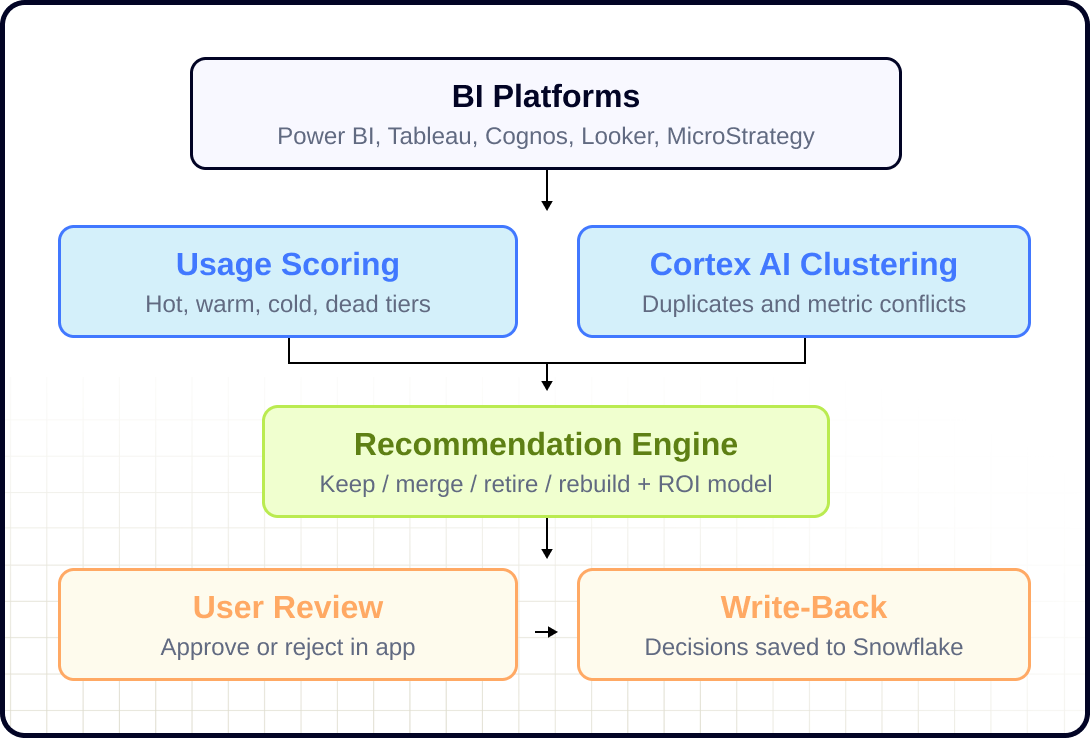
The BI Rationalization Manager turns that mess into a decision engine.
It extracts metadata across platforms like Power BI, Tableau, Cognos, and Looker, scores every asset on a hot-to-dead usage scale, and uses Cortex AI to cluster duplicates. The output is a clear recommendation — keep, merge, retire, or rebuild — backed by migration effort estimates and an ROI projection.
Busra explains: "This app does exactly that: it scans your BI environment to flag dashboards worth retiring, surface duplicates, and catch ungoverned metrics that could be consolidated, removed, or redefined with a cleaner formula. It goes a step further on the license side too — if a user hasn't logged in for three months, the app flags them so you can disable the account and start trimming unnecessary license costs."
There's a Snowflake-specific cost angle too, easy to miss but real. Duplicate workbooks are the usual culprit: "Sometimes you have one workbook with the same name — underscore V1, underscore V2, underscore V3," Busra said. Each version keeps querying Snowflake on its own schedule, burning compute credits whether anyone's looking at it or not. "If you can consolidate all of them or retire them, you will save a lot of compute cost as well."
The use case Busra kept returning to was platform migration — moving from Power BI or Tableau to Sigma without dragging years of clutter along with you. As she put it, the goal isn't to migrate everything: "You don't want to move all of this content to Sigma — maybe you leave behind 20%, migrate the 80% that actually matters, and use the move as a chance to cut what's unnecessary.”
This is also the app that's already outgrown its conference origins. What began as a demo has turned into real client work: "One of our current clients liked the idea, and we're now enhancing this app into an accelerator," Busra said. A three-week proof of concept has become a live engagement."
Workforce Intelligence: Cortex Code Matches the Right Person to the Right Project in Seconds
Resource allocation at most organizations is manual, reactive, and dependent on someone remembering who's good at what. Busra put it simply: a new project comes in with a clear set of requirements, but no clear way to match them to people. "You don't know which resource you have to pick because... maybe you don't know their qualifications yet."
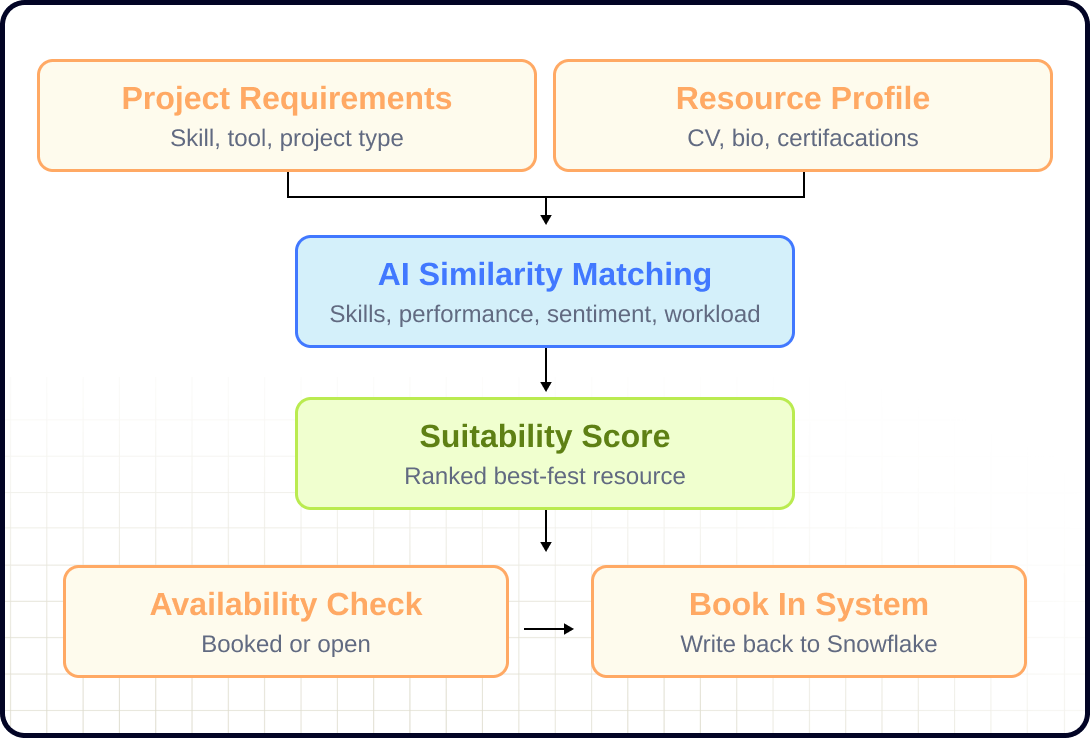
Workforce Intelligence closes that gap with AI-driven similarity matching, comparing a project's requirements against what's actually documented about each resource — CV, bio, certifications — and surfacing the right people from a simple keyword search.
"Type in a skill like DBT or a role like data engineering, and the tool searches for matching talent, comparing CVs against the requirements," Busra explained. It doesn't stop at the match. It checks availability and books the resource on the spot.
The matching engine weighs far more than a resume. It factors in historical project performance, manager sentiment, and current workload to produce what Busra called "a holistic suitability score for every employee." That same logic generalizes well beyond staffing consultants: the same architecture extends naturally to clinician scheduling in healthcare and technician dispatch in field services.
“The real value here isn't dollars — it's time. With a single, unified intelligence layer making decisions that used to require pulling executives into a room, the hours saved across an organization's leadership add up fast: fewer meetings, faster calls, and time back for the people whose time costs the most”, explains Busra.
Sales Copilot: Cortex Code-Powered AI Gives Every Client Conversation a Permanent Memory
The third app lives in the unglamorous layer around every client meeting: prep that doesn't happen, notes that vanish into someone's head, follow-ups that get written late or never.
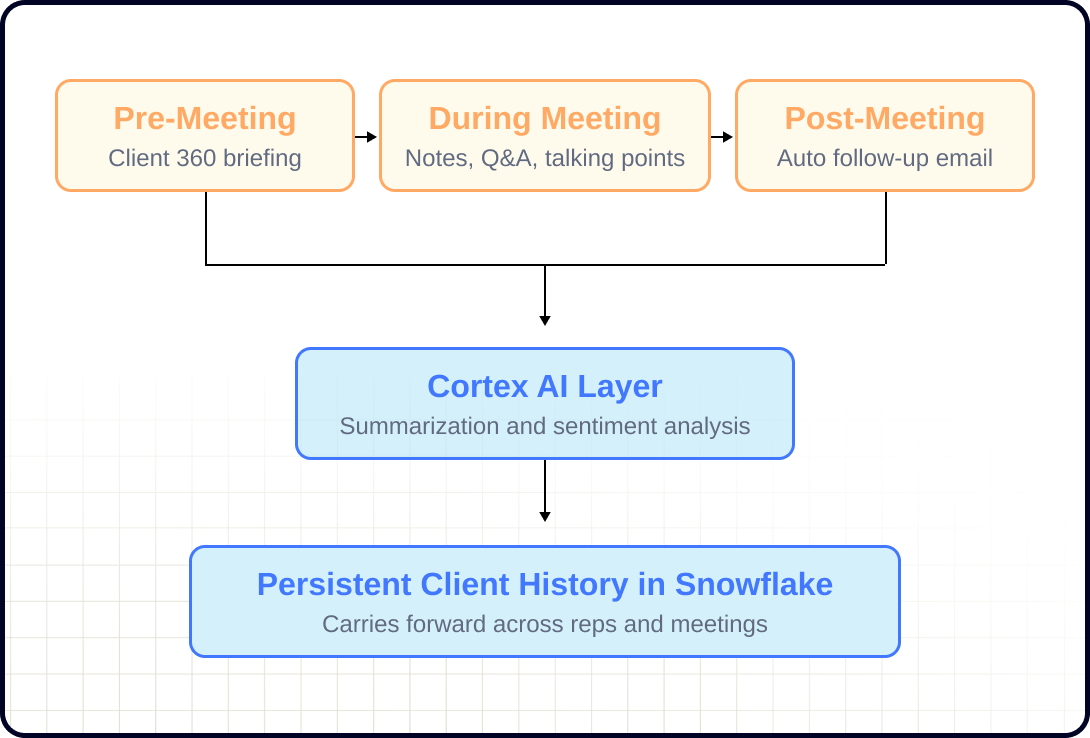
Sales Copilot wraps AI support around all three phases — before, during, and after.
Before the meeting, a user picks a client's name and gets a full briefing assembled automatically. "The app shows you all the public information, all the technical information that you have in your database and in the public Google pool — the whole information about the client," Busra said. During the meeting, it doubles as an on-demand expert:
"If a salesperson hits a knowledge gap mid-conversation — say, a customer mentions SAP and they're not sure what it is — they can search for the answer on the spot, get an instant reply, and that answer becomes part of the system's institutional knowledge going forward."
After the meeting, notes typed into the app become a ready-to-send follow-up email. "It gives the sales team time without creating follow-up emails or anything. Before, during, and after, you will have a copilot with you."
What makes it more than a clever note-taker is the memory underneath. Everything writes back into Snowflake, building a permanent client history that survives staff turnover: "When a salesperson rotates off an account or moves to a new project, none of that institutional knowledge leaves with them — the incoming salesperson inherits the full history instantly: past questions, meeting minutes, emails, all of it."
Cortex Code: The Real Engine Behind all Three Apps
None of the three apps had a real dataset behind them at the start, and building one for each — across three different domains, in three weeks — was never realistic by hand. So the team turned to Snowflake Cortex Code to generate the mock data that powers all three.
Cortex Code is a fully autonomous AI coding agent built directly into the Snowflake platform, working across the CLI, IDE, and Snowsight UI with native awareness of your schemas, semantic models, and governance policies. That's the difference between a tool that suggests code and one that actually scopes, builds, tests, and refines a dataset end-to-end.
Cortex Code is the engine behind BlueCloud's production wins — cutting a global investment firm's cost-visibility framework from a week to a single day, and compressing a support-automation rollout from hours of manual work to minutes for an investment management leader.
"We had no real-world data to work with, so Cortex Code generated it for us — we defined the scope; it built a structurally realistic dataset, and we layered in a manual refinement pass at the end," Busra said.
That's the workflow worth naming: scope the app, let Cortex Code generate a structurally realistic synthetic dataset, then refine by hand. It's the difference between three people building three datasets from scratch, and three people shipping three finished applications in the same span of time.
For the deeper technical story on what sets Cortex Code apart from a typical AI coding assistant, BlueCloud's two-part series is worth the read:
Part 1 covers how it operates across real development environments compared to Databricks Genie Code
Part 2 digs into the business-context and semantic-intelligence layer that makes its outputs trustworthy enough to ship.
Your Idea Could Be the Next Production AI App — Let's Build It
What started as a conference showcase has become proof of a repeatable model: scope an idea, let Cortex Code handle the heavy lifting, and ship a working AI application in weeks rather than quarters. One of the three apps has already become a live client accelerator.
This is exactly the kind of outcome that earned BlueCloud recognition as a Snowflake Cortex Code Preferred Partner — built for AI-powered delivery and for moving organizations from AI experimentation to production outcomes.
If you're exploring what a native, AI-powered application on Snowflake could do for your business, BlueCloud can help you get there. Explore BlueCloud's AI & Machine Learning services to learn more.